
Dog Training
French Bulldogs and Cats: How to Introduce Them Properly
A step-by-step introduction that works, what makes Frenchies easier and harder than other breeds, the eye injury risk nobody mentions, and the signs it isn't going well.

Table of contentsContents
Plenty of French Bulldogs live happily with cats. Getting there is mostly about not rushing the first few weeks, and about knowing which parts of this breed help and which don’t.
If you want the general version for any dog, our guide to helping cats and dogs get along covers it. This one is about Frenchies specifically.
What makes a Frenchie a good bet
They were bred as companions rather than hunters, and most have little interest in chasing small animals. They’re also small: a cat facing a 25-pound dog is in a very different situation from one facing a 70-pound one. And they’re usually sociable, which helps.
None of that guarantees anything. Individual dogs vary, and a Frenchie who has learned that chasing the cat is a great game will keep doing it.
What makes a Frenchie harder
Their eyes. This is the one nobody mentions. A cat’s claws are exactly at Frenchie eye height, and flat-faced breeds have prominent eyes in shallow sockets. Brachycephalic dogs have over 11 times the risk of corneal ulcers compared with other dogs (RVC VetCompass), and ulcers in these breeds can deteriorate quickly. A swipe that would leave another dog with a scratched nose can cost a Frenchie an eye. Any squinting, pawing at the face, redness or cloudiness after contact with a cat is a same-day vet visit.
Excitement. A Frenchie who chases can’t do it for long without getting into trouble. Flat-faced dogs overheat and struggle for breath quickly (PDSA), so a game of chase around the house is a worse idea than it looks.
Food. Cat food is richer than dog food and a Frenchie will happily clear the bowl, which this breed does not need. The litter tray is the other magnet, and eating litter or feces risks both an upset stomach and parasites.
Before they meet
Set the house up first. This is the part people skip, and it’s the part that does the work (VCA Animal Hospitals).
- Give each animal its own space with everything it needs: bed, bowls, toys, and for the cat a litter tray and a scratching post. A new arrival should spend the first few days in their own room rather than meeting everyone at once.
- Give the cat height. Cat trees, shelves, a cleared windowsill. A cat who can get above the dog is a cat who can watch on its own terms, and a scratching post with a perch does both jobs.
- Put the cat’s food up high and the litter tray somewhere the dog can’t follow, behind a baby gate or a cat flap in a door.
- Plan an escape route for each animal from the room where they’ll meet.
Swap scents before sight. Exchange bedding and toys between them, and let each explore the other’s space while the other is shut away (VCA). Then feed them on opposite sides of a closed door, so the smell of the other animal comes with dinner (ASPCA). Move the bowls closer over several days, and go back a step if either stops eating.
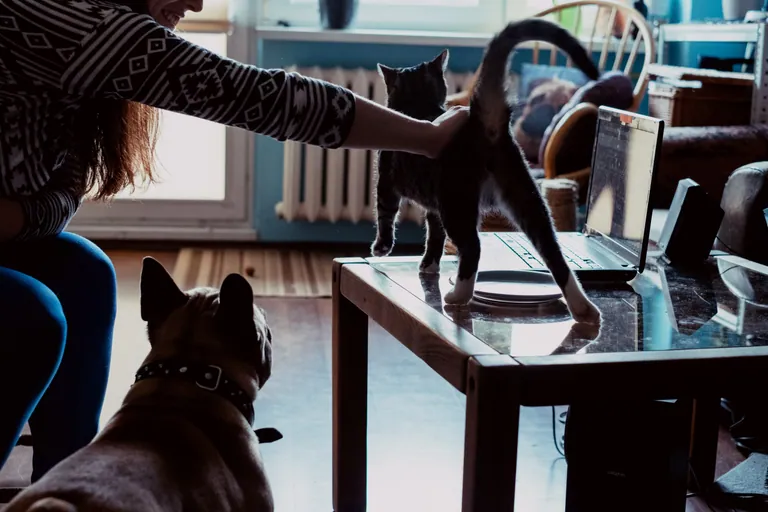
The introduction, step by step
- Through a barrier first. Prop the door open a crack, or use a baby gate the cat can pass but the dog can’t. Let them see each other while something good happens on both sides: treats, dinner, a toy.
- Then in the same room, with the dog on a lead. Have a second person handle the cat, or better, let the cat come and go freely while you keep hold of the dog. Never hold the cat in your arms during a first meeting; a startled cat will climb you to escape.
- Let the cat set the pace. Most cats go high and watch. That’s a good outcome, not a failure.
- Reward calm. Feed your dog for looking at the cat and then looking back at you. Reward-based methods work best and do the least harm (AVSAB). If your dog is fixated and won’t take food, they’re over threshold: increase the distance.
- Keep it short. A few minutes, ending while both animals are still relaxed. Two short sessions a day beat one long one.
- Build up slowly over days and weeks, extending the time as the novelty fades, until they can share a room while you get on with something else.
A settled adult dog with a confident cat might take a couple of weeks. A boisterous puppy with a nervous cat can take months. There’s no schedule worth chasing.
Leaving them alone together
Not until you’ve seen consistently relaxed behavior for a long stretch, and even then, build up gradually and keep the cat’s escape routes open. Until that point, separate them properly whenever you go out: two rooms with a closed door, not a hope and a baby gate. Several months is normal, and some households never get there entirely, which is fine as long as everyone has their own space.
Signs it isn’t going well
In the dog: a hard stare, stiff body, whining or barking at the cat, refusing food near the cat, or repeatedly trying to get to them. Chasing that’s been rehearsed a few times becomes a habit fast.
In the cat: hiding all day, not eating, not using the litter tray, a tail that thrashes, flattened ears, or swatting. A cat who stops using the tray or stops eating is a cat under real stress, and that’s a vet call as well as a management problem.
If either animal is genuinely frightened or your dog can’t be redirected, stop and get help from your vet or a qualified behaviorist rather than pushing on. Pushing a frightened cat into contact is how you get an injury and a lasting problem.
Small things that help for a long time
- Feed them apart, permanently.
- Keep the litter tray out of reach, and keep it clean.
- Give the cat routes around the house at height.
- Trim the cat’s claws, which helps the eye problem.
- Don’t let chasing start, even in play. It’s much easier to prevent than to stop.
- Keep giving each animal attention separately, so neither has to compete for you.
The short version
Set the house up, swap scents, feed either side of a door, meet through a barrier, then meet on a lead with the cat free to leave. Keep sessions short, reward calm, and don’t leave them alone together for months. For a Frenchie, watch the eyes above all: a scratch to a prominent eye is the injury that turns a manageable situation into an emergency.