
French Bulldog
What Questions Should You Ask Your French Bulldog Breeder?
Questions to ask a French Bulldog breeder before you buy, from meeting the mother and seeing where the puppies are raised to health testing, vaccination records and the purchase contract.
Table of contentsContents
Choosing a breeder is almost as important as choosing the puppy. A French Bulldog’s health and early socialization start long before you bring them home, and a good breeder will be glad you asked hard questions. If a breeder can’t or won’t answer the ones below, keep looking.
Why you need to be picky about your French Bulldog breeder
Puppies usually stay with their litter until at least 8 weeks old, and the first three months of life are the most important time for socialization (AVSAB). So much of a puppy’s early learning happens while they’re still with the breeder: meeting people, hearing household noises, and learning from their mother and littermates.
Health starts there too. French Bulldogs are prone to breathing problems and other conditions linked to their build, which our guide to French Bulldog health issues covers, so it matters whether the parents were screened before they were bred.
Where the puppy comes from matters as well. Puppies sold through pet stores and websites mostly come from mass breeding facilities, better known as puppy mills, and a responsible breeder sells only to people they’ve met (Humane World for Animals). Online listings carry another risk: French Bulldogs are among the breeds most often used in puppy scams.
Questions to ask a French Bulldog breeder
A responsible breeder expects questions and will answer them openly. These aren’t the only questions worth asking, but they cover the essentials.
How many dogs and litters do they have?
Raising a litter well takes a lot of time: handling the puppies, cleaning up after them and introducing them to new people and experiences. Responsible breeders keep their numbers small and usually work with just one or a few types of dog (Humane World checklist). They don’t always have puppies available, and many keep a list of interested families for the next litter instead.
Be wary of a seller who always has puppies ready to go, or who sells several breeds at once. The French Bulldog Rescue Network includes both in its red flags for breeders.
Can you meet the mother?
Ask to meet the puppies’ parents, or at least the mother. She should be with her litter, interacting with the puppies and looking comfortable and settled (AKC). Watch how she reacts to you. A mother dog can be a little protective of her puppies, but she shouldn’t be fearful or aggressive. Check her condition as well: she should look clean and healthy, at a good weight.
Puppies learn a lot from their mother and littermates, including not to bite too hard and how to read other dogs, which is why 8 weeks is a good minimum age for leaving the litter (Cornell University College of Veterinary Medicine). AKC suggests 8 to 10 weeks, and most US states that set a minimum age for selling puppies set it at 8 weeks. A breeder offering a younger puppy is a red flag.

Are the puppies raised in the home?
Small breeds like the French Bulldog should be raised in the house, not kept in crowded kennels or cages. A responsible breeder will happily show you every area where the puppies and adult dogs spend their time. Puppies raised indoors grow up around everyday sounds, visitors and routines, which is the kind of gentle exposure they need during their socialization period.
Is it clean?
The puppies’ living space should be clean, roomy and well kept. That matters for their health, and for house-training too: while they’re with their mother, puppies learn to go to the bathroom away from where they sleep. The puppies themselves should look lively and well fed.
How do the puppies respond to visitors?
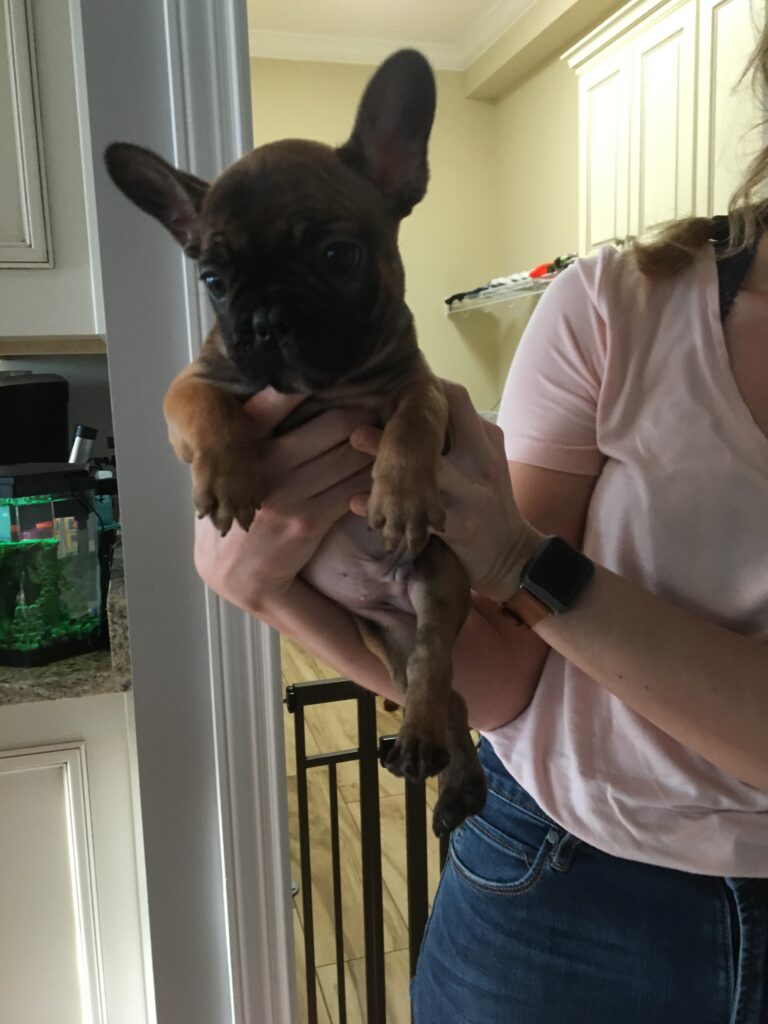
Puppies who are used to people should be curious about you, even if some take a little while to come over. If the whole litter shrinks away from you, that isn’t a good sign. Very young puppies, around three weeks old, may not approach you yet, but a 7- or 8-week-old puppy who is frightened of visitors may not have had enough socialization, or may be anxious by nature.
Don’t try to read a puppy’s whole future from one visit, though. Research on puppy temperament tests has found they don’t predict adult behavior.
How do the puppies respond to sounds?
A well-socialized puppy shouldn’t be too alarmed by normal household noises, like a door closing or a phone ringing. A startle is fine, as long as the puppy recovers quickly and goes back to playing, sleeping or investigating the noise.
Have the puppies had vaccines and deworming?
By the time they go home, puppies should have started their vaccines and deworming, and a responsible breeder can show you the veterinary records.
The core puppy vaccines, which protect against distemper, parvovirus, adenovirus (hepatitis) and parainfluenza, start at 6 to 8 weeks and continue as a series of boosters. Rabies isn’t part of that first round. Puppies can’t have a rabies vaccine until they’re at least 12 weeks old, so an 8-week-old won’t have had one yet. Other vaccines, such as leptospirosis, depend on your dog’s lifestyle and your vet’s advice.
Deworming starts even earlier. The Companion Animal Parasite Council recommends deworming puppies from 2 weeks of age and repeating it every 2 weeks (CAPC). Ask to see the dates.
Have the parents been health tested, and can you see the results?
French Bulldogs can inherit health problems, so ask which screening tests the parents had and ask to see the results. A responsible breeder can explain the breed’s inherited problems and show documentation that the parents were evaluated.
For its health program, the French Bull Dog Club of America requires four evaluations, with the results registered with the Orthopedic Foundation for Animals (OFA):
- hips (an OFA X-ray evaluation or PennHIP)
- eyes, examined by a board-certified veterinary ophthalmologist
- patellas (kneecaps)
- the heart
The club also recommends tests for tracheal hypoplasia, elbow dysplasia, juvenile hereditary cataracts and cystinuria, and the Respiratory Function Grading Scheme. That scheme grades a dog’s breathing from 0 to 3 for signs of BOAS (brachycephalic obstructive airway syndrome), before and after a short exercise test, and breeding from grade 3 dogs isn’t recommended (Royal Kennel Club). Dogs can be graded from 12 months old.
No test covers every condition, so ask about the parents’ general health too, and whether earlier litters had any problems.
Does the breeder ask you questions too?
A good breeder wants to know their puppy is going to the right home. Expect questions about dogs you’ve had before, who lives with you, your work schedule and where the puppy will live. Some breeders ask for proof that your landlord allows dogs, or for a reference from your vet.
They should also be honest about the breed and the individual puppy, give you guidance on care and training, and stay available to help after the puppy goes home. A breeder who seems interested only in closing the sale, or who doesn’t ask you anything, is a warning sign.
Does the process feel rushed?
You should be able to take your time, visit more than once and ask everything you need to. Pressure to decide on the spot is a classic warning sign, from breeders and scammers alike. Be wary of a demand for a non-refundable deposit, too.

Is there a clear written contract?
Ask for a written contract, and give yourself time to read it before you sign. A breeder contract usually includes the puppy’s registration number, the parents’ names and registration numbers, and the price (AKC). Also look for:
- a health guarantee, and exactly what it covers (the French Bulldog Rescue Network suggests at least one year)
- a spay or neuter requirement for a pet puppy
- a return-to-breeder clause, which means the dog goes back to the breeder if you ever can’t keep them
- who legally owns the dog, so you don’t find yourself a co-owner with conditions you didn’t expect
Don’t sign anything you don’t intend to honor. If a clause is unclear or makes you uncomfortable, talk it through with the breeder first.
Red flags to walk away from
Walk away, or at least slow down, if a seller:
- won’t let you visit, see where the puppies live or meet the mother
- always has puppies available, or sells several breeds
- can’t show health testing for the parents
- offers a puppy younger than 8 weeks
- won’t meet in person or do a video call, or offers to ship a puppy you haven’t seen
- adds charges for shipping, crates or vaccinations after you’ve agreed on a price
- offers a popular breed at a surprisingly low price
- pushes you to decide quickly or to pay a non-refundable deposit
- doesn’t ask anything about you or your home
These warning signs come from the BBB’s research on puppy scams and the French Bulldog Rescue Network’s red flags. Whoever you’re buying from, see the puppy in person before you pay any money.
When in doubt, keep looking
When you’re ready for a new dog, it’s natural to want one home tomorrow. Take your time anyway. Good breeders often have waiting lists, and the French Bulldog Rescue Network advises being prepared to wait several months for the right puppy.
Sometimes a breeder answers every question well and something still doesn’t feel right. That’s okay. If you have doubts, don’t buy. This decision affects your family, and a dog, for many years.
Once you’ve found your puppy, the fun part starts. Our guides to French Bulldog food, walks and playing together will help you get started. Still deciding between a breeder and a rescue? See buying or adopting a French Bulldog.