
French Bulldog
The Best Harness for a French Bulldog (and How to Fit It)
Why French Bulldogs should walk in a harness rather than a collar, the harness types that suit a flat-faced breed, how to measure and fit one, and which to consider.

Table of contentsContents
A French Bulldog should walk in a harness. That isn’t a style preference: pressure on the neck makes breathing harder for a breed that already works at it, and a body harness spreads the load across the chest instead.
This guide covers why, which type suits a Frenchie, how to measure and fit one properly, why you still need a collar, and the harnesses worth a look.
Why a harness rather than a collar
Many French Bulldogs have brachycephalic obstructive airway syndrome, and the advice for flat-faced dogs is to walk them on “a harness instead of their collar — pressure on their neck will make breathing more difficult” (PDSA). The RSPCA gives the same guidance for brachycephalic breeds: walk on a harness rather than a collar and lead, “to avoid putting pressure on their neck and help them breathe easier” (RSPCA).
There’s a broader point too. A body harness “puts minimal pressure on delicate tissue and is less likely to cause injury,” which makes it an excellent choice for dogs with tracheal disease or neck pain (VCA Animal Hospitals).
Keep the collar for ID tags. Use the harness for the leash.
You still need a collar
A harness replaces the collar for walks, not for identification. Your Frenchie should still wear a flat, well-fitted collar carrying an ID tag with your phone number, so that anyone who finds them can reach you quickly. A slide-on ID tag sits flat against the collar and doesn’t jingle.
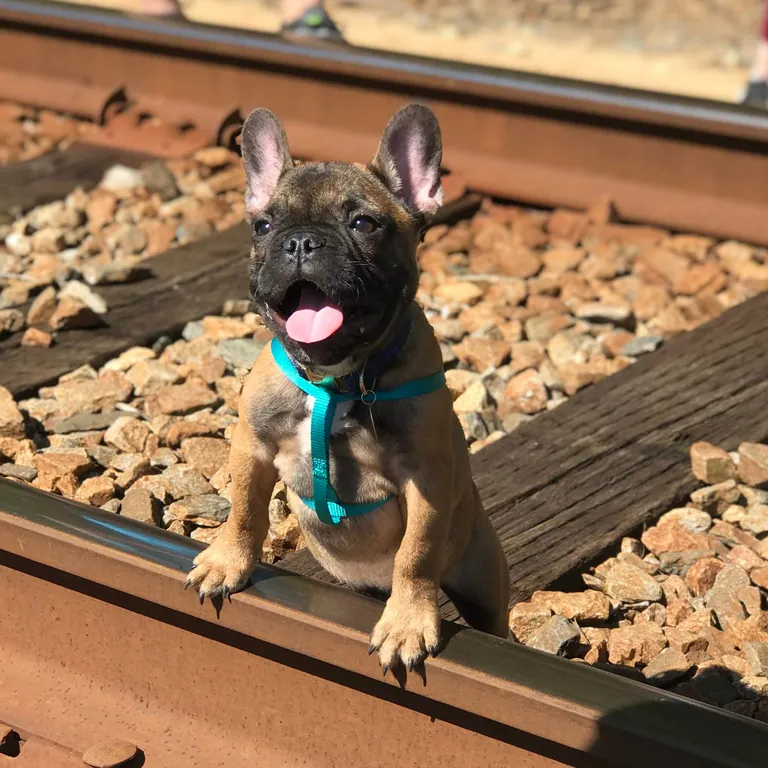
Clip the leash to the harness, never the collar. Check the collar isn’t tight, especially on a growing puppy, and have your dog microchipped as a backup in case the collar comes off, keeping your contact details with the registry up to date.
Which type suits a French Bulldog?

Back-clip
The leash attaches between the shoulders. It keeps the leash clear of the front legs and puts no pressure on the throat, and back-clip harnesses are a good option for flat-faced dogs (AKC). The trade-off is leverage: a dog who pulls can lean into it.
Best for a calm walker, and the easiest type for most Frenchies.
Front-clip
The leash clips at the chest, so a pulling dog gets turned gently back toward you rather than hauling forward. Front-clip harnesses reduce a dog’s ability to pull you along (AKC). The leash can tangle round a front leg, which a shorter leash mostly solves.
Best for a dog who pulls.
Dual-clip
Rings front and back, so you can switch depending on the walk, or use a double-ended leash for more control. More versatile, usually a little pricier.
Head halter
A strap around the muzzle steers the head. Effective for strong pullers, but a poor match for a French Bulldog: there’s very little muzzle to sit on, and some dogs never tolerate one even with careful conditioning (VCA Animal Hospitals). For a 25-pound dog you can simply pick up, it solves a problem you don’t have.
Support or rehabilitation harness
A sling that goes under the body with a handle on top, so you can take weight off the back legs. Genuinely useful for a dog recovering from surgery, or one with intervertebral disc disease, which French Bulldogs are prone to. Not an everyday walking harness.
Getting the fit right
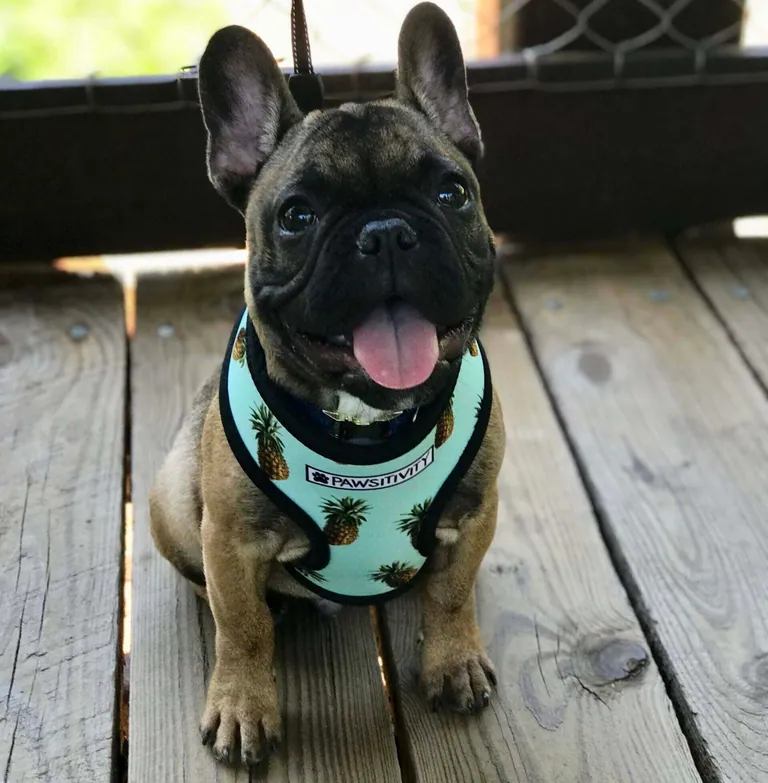
A badly fitted harness rubs, restricts the shoulder, or slips off entirely. Frenchies are awkward to fit: a broad chest, a short body, and a neck nearly as thick as the head.
- Measure, don’t guess. Put a soft tape around the widest part of the chest, just behind the front legs, and measure the neck where it meets the shoulders.
- Check both numbers against the maker’s chart. Weight alone is a poor guide for this breed.
- Use the two-finger rule. You should be able to slide two fingers under any strap, snugly (AKC).
- Watch the armpits. Straps shouldn’t rub behind the elbow. That’s where sore patches appear first.
- Buy adjustable, and size up rather than down if you’re between sizes, then adjust in.
- Re-check as they grow, and after any weight change.
Harnesses worth considering
There’s no single best harness for the breed, because it depends on your dog’s shape and how they walk. The lineup below covers the common situations: a puller, an easy walker, a dog who needs options, a hard-wearing everyday option, and a dog who needs physical support.
- A front-clip harness like the PetSafe Easy Walk is the one to try if your Frenchie pulls. It was designed by a veterinary behaviorist and steers rather than corrects.
- A step-in mesh harness like the Voyager is the simplest for daily walks: your dog steps in, you clip it on the back, and the mesh stays light in warm weather.
- A dual-clip harness like the Auroth gives you both attachment points, useful while a young dog is learning leash manners.
- A padded everyday harness such as the Ruffwear, Chai’s Choice or EcoBark options suits dogs who wear a harness for hours at a time; look for wide, padded straps that clear the elbows.
- A support sling like the GingerLead is for mobility problems rather than walks, and it’s the one to know about before you need it.
Other dual-clip designs are worth comparing too: padded no-pull vests like the Embark and rabbitgoo put a ring at the chest and another on the back, and the URPOWER comes as a harness-and-leash set.
Check the sizing chart for whichever you choose against your own measurements, because sizing varies a lot between makers.
Teaching your dog to wear it
Some Frenchies object to anything going over their head. Take it slowly and pay for cooperation: reward-based methods do the least harm and produce the best long-term results, and methods relying on force or discomfort shouldn’t be used (AVSAB).
- Leave the harness on the floor with treats scattered around it for a day or two.
- Hold it up, feed a treat, put it away. Repeat until your dog moves toward it.
- Fasten it for a few seconds indoors, then take it off and feed.
- Build to a few minutes indoors with a game, then take the first walk in it.
A step-in style avoids the over-the-head step entirely, which is often enough on its own.
Everyday safety
- Take the harness off in the crate and during rough play. Straps catch on things.
- Check the skin under the straps while you’re grooming, especially behind the elbows.
- Don’t leave a wet harness on. Damp webbing against skin folds invites trouble.
- Replace worn hardware. A cracked buckle fails at the worst moment.
The short version
Walk your French Bulldog on a harness, not a collar. Measure before you buy, fit it with two fingers of room, and choose the clip position to suit how your dog walks. Then keep the walks short and cool, which our guide to walking a French Bulldog covers, and let the harness do its job.