
Dog Training
How to Stop a French Bulldog Barking Excessively
Find the trigger, then change it. Why Frenchies bark, how to teach quiet with rewards, and why spray bottles and bark collars are the wrong tool for the job.
Table of contentsContents
French Bulldogs aren’t among the noisier breeds, but they do bark, and a dog who barks at every passer-by wears everyone down. The fix is almost never “make the barking stop” directly. It’s working out what your dog is barking at, then changing that.
First, find the trigger
Barking isn’t one behavior. A dog barking at the window, a dog barking at you for attention and a dog barking alone in an empty house need completely different answers.
Spend a few days writing it down: what happened immediately before, what time, who was home, how long it lasted. Most owners discover their dog doesn’t bark at “everything” after all. It’s people with bags, or children, or cyclists, or the moment you pick up your phone.
Common reasons:
- Alert barking at the door, the window, or a noise outside.
- Attention barking, which works, because it usually gets a response.
- Boredom and frustration, especially in a dog who has slept all day with nothing to do.
- Distress at being left alone, which usually comes with pacing, destruction or accidents.
- Pain or illness, particularly if the barking is new in a settled adult (AVSAB).
- Excitement, which is its own category and mostly passes with age and practice.
If the barking started suddenly and nothing in the household changed, start with your vet.
What actually works
Change what your dog can see and hear
The fastest wins are environmental. If the trigger is the window, use frosted film on the lower half or move the sofa your dog stands on. If it’s noise outside, a radio or white noise covers a lot. If it’s the doorbell, disconnect it for a fortnight while you train.
Management isn’t cheating. Every bark your dog rehearses makes the habit stronger, so preventing the rehearsal is half the job.
Reward the quiet
Most people only notice their dog when the dog is barking, which means quiet earns nothing. Flip that: when your dog notices something and doesn’t bark, mark it and pay. When a dog stops barking, wait for two seconds of silence, then reward.
You’re teaching a simple rule: quiet pays better than noise (AVSAB).
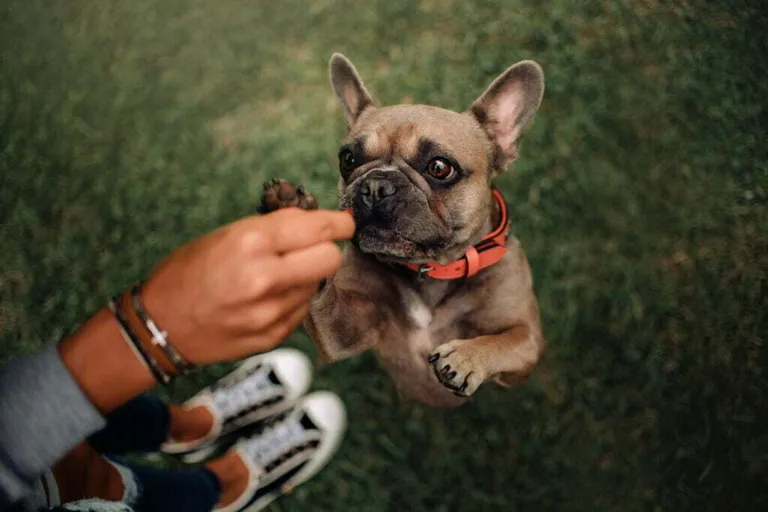
Teach “quiet” properly
- Let your dog bark a couple of times at a mild trigger.
- Say “quiet” once, calmly, and hold a treat to their nose. Most dogs stop to sniff.
- The moment they’re silent, mark it with “yes” and feed.
- Build the gap: two seconds of silence, then five, then ten, before the treat arrives.
Say it once. Repeating “quiet quiet quiet” at increasing volume teaches your dog the word means nothing, and shouting adds to the excitement, since to a dog it sounds like you’ve joined in.

Pair the word with a hand signal from the start. Dogs follow gestures better than words when the two are separated (D’Aniello and colleagues, 2016), so a visible signal is worth having for moments when your dog can’t hear you over their own noise.
Teach an alternative
A dog can’t bark at the window and lie on a mat at the same time. Teaching “go to your bed” when the doorbell rings, and paying well for it, gives your dog a job that isn’t barking. Our training guide covers building that kind of cue.
Meet the needs behind it

A bored, under-slept Frenchie barks more. Short walks in the cool part of the day, sniffing games, a stuffed KONG and a couple of five-minute training sessions do more for barking than any correction. Our guides to playing with your French Bulldog and hyperactivity cover the enrichment side, and puppies in particular need far more sleep than people expect.
Ignore attention barking, properly
If the barking is aimed at you, look away, stay silent, and wait. Reward the instant it stops. Expect it to get louder before it gets better, because a behavior that used to work always escalates before it fades. If you give in at the loudest point, you’ve taught your dog to go straight there next time.
Why not spray bottles and bark collars
Earlier versions of this article recommended spraying water in a dog’s face and using citronella or shock bark collars, with the advice to test the collar on yourself first and start on the lowest setting. That advice is gone, and it’s worth saying why.
The veterinary behavior position is that reward-based methods should be used for training and behavior problems, and that methods relying on fear, pain, force or startle “should not be used” (AVSAB). Dogs trained with aversive methods show more stress behavior and more behavior problems, not fewer.
Practically, these tools have three problems:
- They punish the symptom, not the cause. A dog barking because they’re frightened of the delivery driver is still frightened; now they’re frightened and getting hurt or startled while the driver is there, which can make the fear worse.
- They can suppress the warning. A dog who learns barking brings something unpleasant may stop warning and escalate straight to growling or snapping.
- They’re indiscriminate. A bark collar fires for the dog’s own bark whatever the reason, including pain, distress or another dog barking nearby.
“Test it on yourself” isn’t a safety standard either. A device you can tolerate on your palm is a different thing on a small dog’s throat, with a flat-faced breed’s airway underneath it.
If you’ve already tried one of these, you haven’t ruined your dog. Stop using it, go back to managing the trigger and rewarding quiet, and get help if the barking has become entangled with fear.
Barking when you leave
This one is different. A dog who barks, howls, paces, destroys things or has accidents only when alone is showing separation anxiety, not a training problem, and no amount of quiet-command work will fix it. Crating an anxious dog can make it worse (VCA Animal Hospitals).
Record your dog while you’re out, so you know what you’re dealing with, and read our separation anxiety guide. This is one to take to a vet or behaviorist early.
When to get help
See your vet if the barking is new in an adult dog, if it comes with any sign of pain or illness, if your dog seems frightened rather than bossy, or if it only happens when you’re out. Your vet can rule out pain and refer you to a qualified, reward-based trainer or behaviorist.
The short version
Watch for a few days and find out what your dog is actually barking at. Change what they can see and hear, pay generously for quiet, teach a “quiet” cue and an alternative behavior, and make sure they’re sleeping and doing enough. Leave the spray bottles and bark collars alone: they make the dog quieter at best, and more anxious at worst.