
Dog Training
How to Train a French Bulldog: The Basic Commands, Step by Step
How to teach a French Bulldog sit, down, come, stay and leave it with short, reward-based sessions, when to start, how to socialize a puppy, and why Frenchies seem stubborn.

Table of contentsContents
French Bulldogs can learn everything a pet dog needs to know. They have a reputation for being stubborn, but most of what gets called stubbornness is a dog who isn’t motivated enough, is confused about what you want, or is tired. Get those three right and a Frenchie is a willing student.
This guide covers when to start, how to run a training session, and step-by-step instructions for five basic commands: sit, down, come, stay and leave it.

When to start
Start the day your puppy comes home. There’s no need to wait until six months; young puppies learn quickly, and the habits they form early are the ones that stick.
Socialization matters even more than commands at this age. The first three months of life are the most important time for socialization, and the American Veterinary Society of Animal Behavior recommends puppy classes from as early as 7 to 8 weeks, provided the puppy has had at least one set of vaccines at least 7 days before the first class and a first deworming (AVSAB). It makes the point bluntly: behavior problems, not infectious disease, are the leading cause of death in dogs under three.
How to run a training session
Keep it short. Several three-to-five-minute sessions a day work far better than one long one, especially with a puppy.
Watch the breathing. Flat-faced dogs tire and overheat quickly. If your Frenchie starts panting hard or slowing down, stop (PDSA). Train in a cool room, not straight after a walk on a warm day.
Start somewhere boring. Teach each new command in a quiet room with nothing else going on. Once your dog has it, practice in the yard, then on walks, then around other people and dogs.
Pay well, in small change. Use tiny, soft treats your dog loves. Treats should stay within about 10% of daily calories (VCA Animal Hospitals), and a Frenchie gains weight easily, so break treats into pieces the size of a pea and take them out of dinner. A small, soft training treat like Zuke’s Mini Naturals is easy to break up.
End on a win. Finish every session with something your dog finds easy, so training stays something they look forward to.
Reward, don’t punish. Reward-based training offers the most advantages and the least harm, and methods that rely on force, pain, fear or startle shouldn’t be used (AVSAB). Shouting, jerking the lead or startling your dog makes training slower, not faster.
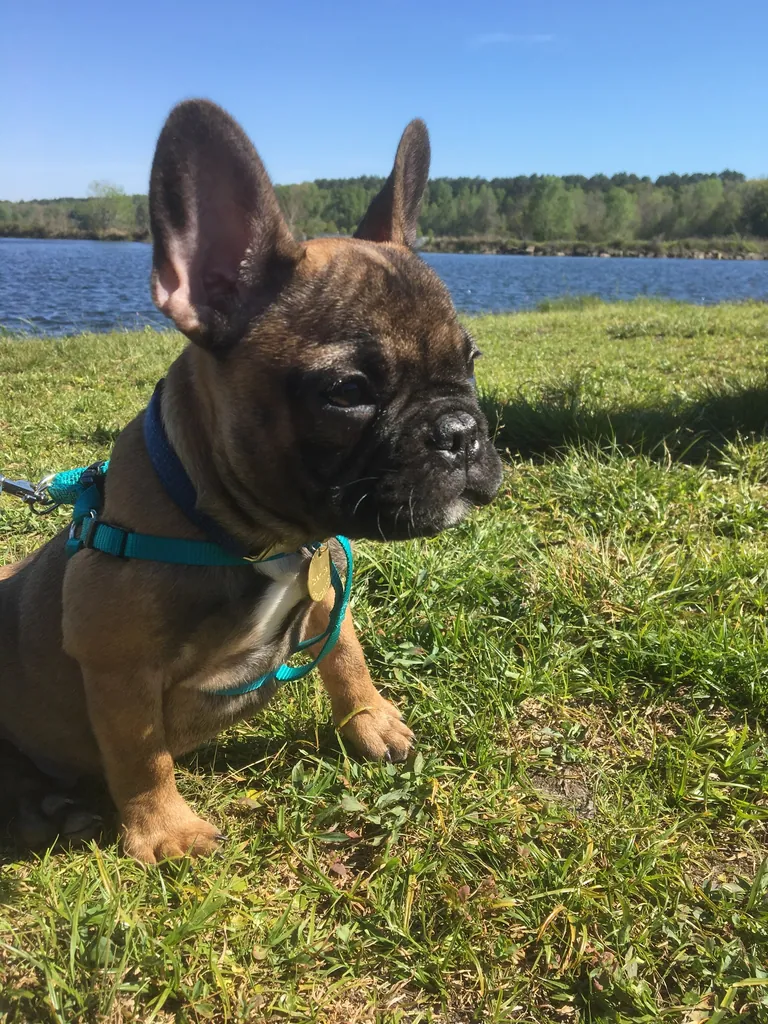
Sit
Sit is usually the first command, and the easiest.
- Hold a treat close to your dog’s nose.
- Slowly move it up and back over the top of their head.
- As their head goes up to follow the treat, their rear will go down.
- The moment their bottom touches the floor, say “yes” and give the treat.
Repeat a few times. Once your dog is sitting reliably as your hand moves, start saying “sit” just before you move your hand. Over the next few sessions, make the hand movement smaller until the word alone is enough, and switch from rewarding every sit to rewarding most of them.
Down
Down is easier to teach once your dog knows sit. Use “down” only for lying down; pick a different word, like “off”, for getting off the sofa, so the two don’t blur.
- Ask for a sit.
- Hold a treat at your dog’s nose and slowly lower it straight down to the floor between their front paws, then slightly forward.
- When their elbows touch the floor, say “yes” and reward.
If your dog stands up instead, you’re moving too fast or too far forward. Go slower. Once they’re following the treat reliably, add the word “down” just before your hand moves, then fade the hand signal.
Come
A reliable recall is the command most likely to keep your dog safe, so make coming to you the best thing that ever happens to them.
- Start indoors with a helper gently holding your dog a few steps away.
- Crouch down, say your dog’s name and “come” in a happy voice, and open your arms.
- When your helper lets go and your dog reaches you, reward with something especially good and lots of praise.
- Repeat a few times, gradually increasing the distance.
Then make it a game. Call your dog from another room, play hide and seek in the house, and practice in the yard with mild distractions.
Some rules keep recall strong:
- Never call your dog to something they dislike, such as a bath or nail trim. Go and get them instead.
- If your dog doesn’t come, don’t chase them; they’ll think it’s a game. Move away from them, calling happily, and they’ll usually follow.
- Never punish a dog who comes to you, however long it took. If coming back leads to trouble, they’ll learn not to.
Stay
Stay takes patience, because you are building duration and distance a second and a step at a time.
- Ask for a sit or down.
- Say “stay” and show a flat palm.
- Wait two or three seconds, then go to your dog, reward and release with a word like “okay”.
- Build up slowly: a few more seconds, then one step back, then two.
Increase only one thing at a time, either time or distance, and if your dog breaks the stay, simply go back to an easier level. There’s no need for a correction. Eventually you’ll be able to step out of sight briefly, which deserves a big reward.
Leave it
“Leave it” teaches your dog to turn away from something they want, and it’s how you stop them picking up something dangerous on a walk. You don’t need to say “no” at all.
- Put a treat in your closed fist and let your dog sniff, lick and paw at it. Say nothing.
- The moment they back off, even for a second, say “yes” and give a different treat from your other hand.
- Once they’re backing off right away, say “leave it” as you present your fist.
- Progress to a treat under your hand on the floor, then an uncovered treat you can cover quickly, then things on walks.
Always reward with something other than the item they left, so they learn that leaving things pays better than taking them. If your dog is in the middle of something you don’t want, it also helps to ask for something they can do instead, like sit or come.
Socialization
A well-socialized Frenchie is easier to train and much easier to live with. During the early months, introduce your puppy to lots of people, other calm and healthy dogs, surfaces, sounds and places, at a pace they’re comfortable with. Let them approach in their own time, reward curiosity, and let them retreat if they want to. Never force a frightened puppy into a situation.
House training and crate training
These have their own guides. Our potty training guide includes a realistic schedule by age, and our crate training guide covers making the crate somewhere your dog wants to be. A crate should never be used as a punishment.
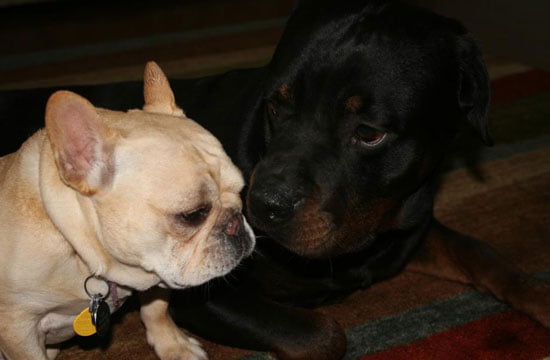
Exercise and walks
French Bulldogs don’t need long walks, and in warm weather long walks can be dangerous for them. A couple of short walks in the cool part of the day and some indoor play are enough. Our guide to walking a French Bulldog explains how far is too far, and our harness guide covers what to walk them in. For more, see our guides to training a French Bulldog to walk off leash and getting along with other dogs.
When it isn’t working
If your Frenchie seems to have stopped listening, check the basics first: are the treats good enough, are the sessions short enough, is it too warm, and is the task too hard for where you’re practicing? Our guide to dealing with French Bulldog stubbornness goes through the usual sticking points.
A dog who growls, snaps, freezes or panics needs more than training. Ask your vet to rule out pain and refer you to a qualified behaviorist.
Keep it up
Once your dog knows the basics, keep using them every day, and make sure everyone in the house uses the same words and rewards the same things. Training never really ends; it just becomes part of how you live together.