Dog Grooming
A Guide to The Best Brush For Huskies
Huskies shed year-round and blow their whole coat twice a year. Five brushes worth considering for a double coat, how to brush properly, and why a dull blade makes shedding worse.

Table of contentsContents
Are you looking for the best brush for Huskies?
The amount of hair a Husky produces is genuinely surprising. Huskies shed year-round and blow their entire coat twice a year, so grooming needs to be part of the routine rather than something you get to eventually.
Otherwise that hair ends up on you, your house, and your visitors.
Here’s how to find the best dog brush for Huskies, and how to use it properly once you have one.
A Little About Your Husky’s Coat
Before the brushes, it helps to understand what you’re brushing — especially if this is your first Husky.
Your Husky has not one coat but two, and they behave very differently.
The Overcoat: Silent Protector
This is the layer you can see — the long guard hairs that give the dog its shape and colour.
It’s ordinary fur, much like a Labrador’s or a Golden Retriever’s, and its job is protection from weather, sun and scrapes.
Underneath it sits a second layer, and that’s the one causing your problems.
The Undercoat: It’s What’s On The Inside
The undercoat is soft, dense, cotton-like hair packed close to the skin. It’s what keeps a Husky comfortable in genuinely cold weather.
It’s also the layer that sheds hardest.
That’s your culprit. And it’s why a brush designed for a single-coated dog will barely touch a Husky — it skims the top and leaves the undercoat where it is.
One thing not to do: people sometimes shave a double-coated dog to cut down on hair, but you should never do that. The undercoat insulates against heat as well as cold, and shaving it off can permanently change how the coat regrows.
What Do I Do About All These Hairs?
If you own a dog, you know dog hair has a way of turning up everywhere.
My dog doesn’t ride in my car. I still find fresh hair on the seats most mornings, and I’ve never worked out how.
If you’re a Husky owner, you’re dealing with that several times over. It’s worth learning how to groom a Husky properly rather than fighting it with a vacuum.
Brushing: Does It Even Help?
Yes, and more than people expect — but only if you do it regularly.
Brushing doesn’t stop a Husky shedding. Nothing does. What it does is collect the loose undercoat in the brush instead of on your sofa, before the dog distributes it around the house.
Ideally, brush daily. Realistically, once or twice a week during normal shedding and daily when the coat is blowing will keep things manageable.
It’s also decent time with your dog, once they’ve decided they like it.
Your Guide To Brushing Your Husky
Before the brushes themselves, a few things about technique. These matter more than which brush you buy.
-
Start when your dog is a puppy if you can. A dog that grew up being brushed will stand still for it. A dog that didn’t will fight you at four years old.
-
Steer clear of the whiskers. Some people trim them off during grooming. Don’t — dogs use them to sense movement and navigate in low light.
-
Don’t skip the legs, stomach and under the tail. These are the spots that mat first, and they’re the ones most people rush.
-
Work in sections and go gently. If the brush snags, stop and work the mat loose rather than dragging through it.
-
You can clip your dog’s nails while you’re at it, since the dog is already settled.
Here’s a useful walkthrough for grooming a Husky:
Let’s Find You The Best Brush For Husky
Below are five brushes worth considering for a double-coated dog, with what each one is actually good at.
A note before you buy: quality matters here more than it does with most pet kit. Cheap deshedding blades dull quickly, and a dull blade drags at the coat and pulls skin instead of cutting loose hair. That’s how dogs learn to hate being groomed.
The Best Brush For Husky: Overview
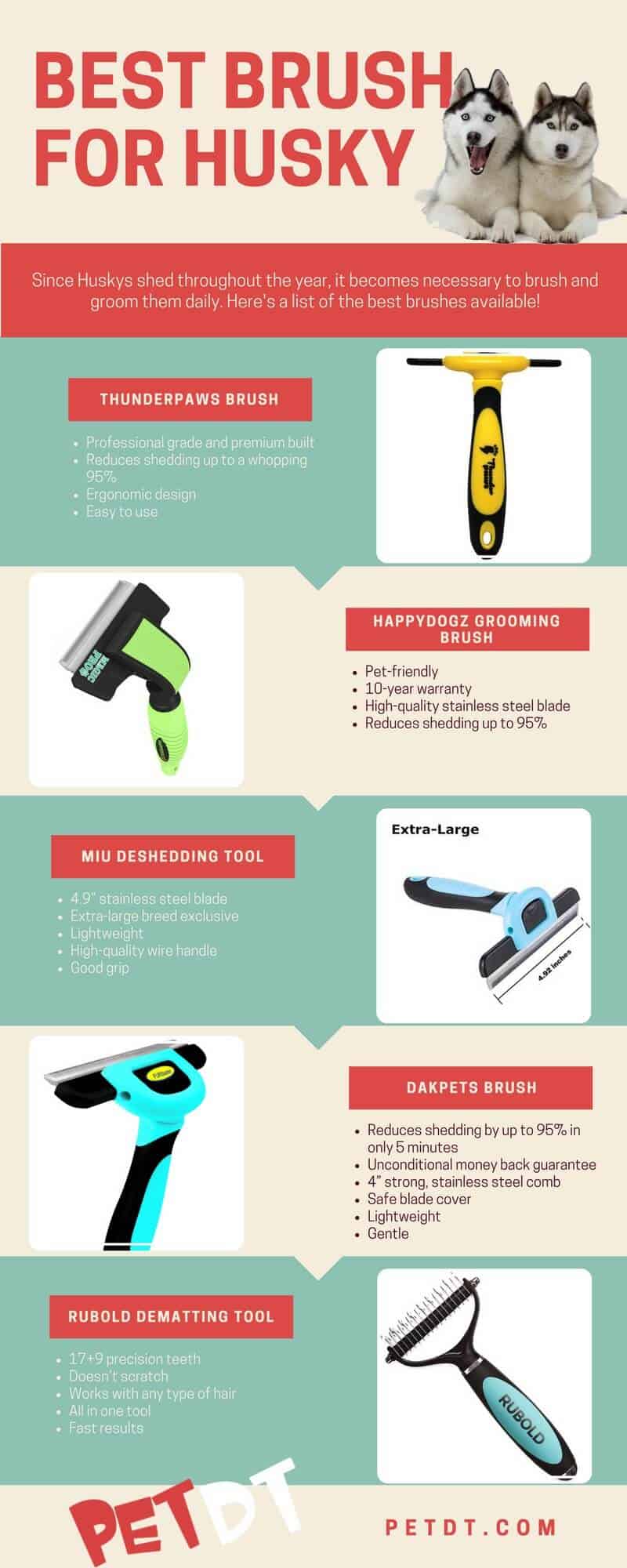
Now let’s go through each one properly — features, and where each falls short.
The Thunderpaws Pet Grooming brush is a solid all-round deshedding tool and a reasonable default if you’re buying your first one.
Key features:
Professional-grade build, so it won’t flex or break mid-groom
Reduces shedding substantially with regular use — how substantially depends entirely on how often you actually do it
Ergonomic handle that’s comfortable to hold for the twenty minutes a full groom takes
Straightforward to use, with no technique to learn
It works smoothly enough that it doesn’t irritate most dogs. You only need light pressure — let the blade do the work rather than pressing down, which is where people go wrong and start pulling healthy hair.
Pros:
- Light and quick
- Comfortable grip
- Sturdy build
- Easy for a beginner
Cons:
- Can pull if you press too hard
- Reaches deeper than some dogs like
- No blade cover, so it needs storing carefully
Worth the money, and a sensible starting point.
The HappyDogz Pet Grooming brush is another reasonable option, and it suits households with more than one animal since it handles both long and short coats.
Key features:
Comfortable for the dog, which matters if yours is nervous about grooming
10-year warranty, which is unusual at this price
Stainless steel blade that holds its edge
Effective on loose undercoat with repeated passes
This one works best on a smaller Husky. On a full-grown adult with a heavy coat it’s harder going, and you’ll be at it longer than with a wider tool.
Pros:
- Light and quick
- Works fast on a manageable coat
- Gentle enough for a reluctant dog
- 10-year warranty
Cons:
- Needs firm pressure on a thick coat
- Struggles with a full adult undercoat
The Miu Color Pet De-shedding Tool is built for larger dogs, and that’s the reason to pick it.
Key features:
4.9” stainless steel blade, wide enough to cover a big dog without endless passes
Aimed at extra-large breeds rather than adapted from a small-dog tool
Lightweight, so your hand holds out through a full groom
Wire handle with a good grip
The extra blade width is the real advantage here. On a dog the size of a Husky, a narrow blade turns a twenty-minute job into an hour.
Pros:
- Light and quick
- Blade width suits a large breed
- Comfortable handle
- Good grip
Cons:
- Needs some pulling through denser patches
- Overkill for a small dog
The DakPets grooming tool has a real following among Husky owners, and it earns it.
Key features:
-
Removes loose undercoat quickly — a noticeable difference in a single session
-
Money-back guarantee
-
4” stainless steel comb, effective without being unwieldy
-
Blade cover included, which the others mostly skip
-
Lightweight and easy to hold
-
Gentle in normal use
The blade cover is a small thing that matters. These blades are sharp, they live in a drawer with everything else, and an uncovered one dulls fast.
Pros:
- Light and quick
- Money-back guarantee
- Safe blade cover
- Gentle on the skin
Cons:
- Blade needs replacing eventually, and replacements aren’t cheap
- 4” is narrower than the Miu Color for a big coat
The HATTIKO dematting tool is a different kind of tool from the four above, and worth having alongside one of them rather than instead of one.
A deshedding blade pulls loose undercoat out. A dematting rake cuts through mats that have already formed — the felted clumps behind the ears, in the armpits and around the tail that a deshedder will simply snag on.
Key features:
- Two sides, 9 teeth and 17 teeth — the coarse side for breaking up a mat, the fine side for working out what’s left
- Rounded tooth ends so it doesn’t scratch the skin underneath
- Works on most coat types, curly or straight, fine or coarse
- Detangles, deshedds and thins depending on which side you use
- Useful across multiple pets if you have more than one
If your Husky has gone a few weeks without a proper groom and you’ve found mats, this is the tool that gets them out without cutting them off.
Pros:
- Handles mats a deshedding blade can’t
- Two tooth spacings for different jobs
- Rounded ends are kinder to skin
Cons:
- Not a substitute for a deshedding tool for routine work
- Takes patience on a badly matted coat
- You can still hurt a dog with it if you rush
The Bottom Line
Huskies shed more than almost anything else you could have chosen, and regular grooming is the only thing that keeps it under control.
If you’re buying one tool, buy a wide deshedding blade. If you’re buying two, add a dematting rake for the spots that felt up.
Here’s what I covered:
- Thunderpaws Pet Grooming Brush
- HappyDogz Pet Grooming Brush
- Miu Color Pet De-shedding Tool
- DakPets Pet Grooming Tool
- HATTIKO Pet Dematting Tool
Whichever you pick, brush little and often. It’s far easier than dealing with a matted coat later.
PetDT Editorial Team
The PetDT Editorial Team manages and maintains our library of legacy pet care content. With experience across a wide range of pets, including dogs, cats, fish, hamsters, and reptiles, the team works to review and improve older articles so they remain accurate, clear, and helpful for everyday pet owners. As PetDT continues updating inherited content, articles credited to the Editorial Team will be reviewed by Mike or Melissa during the update process.
View all posts by PetDT Editorial Team