French Bulldog
Cherry Eye in French Bulldogs: What It Is and How It's Fixed
Cherry eye is a prolapsed tear gland, not a tumour. Why flat-faced breeds get it young, why the gland should be replaced rather than removed, and what surgery involves.
Table of contentsContents
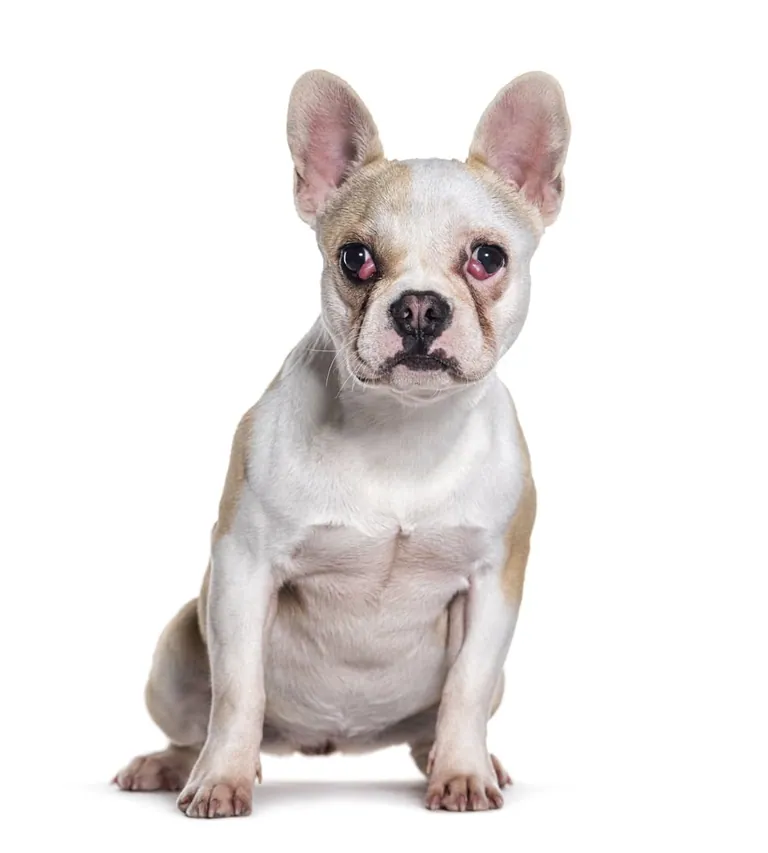
Cherry eye is a red, fleshy lump that appears suddenly in the inner corner of a dog’s eye, usually in a young dog, often overnight. It looks alarming. It isn’t a tumour, and it isn’t an emergency in the middle-of-the-night sense, but it does need a vet.
What you’re looking at is a tear gland that has slipped out of position.
The third eyelid, and the gland on it
Dogs have a third eyelid that sweeps across the eye from the inner corner, spreading tears and protecting the surface. Attached to its base is a tear gland, and that gland produces up to half the watery part of the tear film (VCA Animal Hospitals).
Cherry eye, properly prolapsed nictitating membrane gland, is that gland popping out from behind the third eyelid and sitting exposed at the corner of the eye. Out in the air it swells, reddens and becomes inflamed, which is what gives it the cherry look.
Remember the “half the tear film” part. It’s the reason the treatment section below matters so much.
Why French Bulldogs
It’s a structural, inherited problem: the tissue anchoring the gland is weaker than it should be, so the gland slips. Flat-faced breeds are strongly over-represented.
In a study of 905,543 UK dogs, breeds with brachycephalic skulls had 6.71 times the odds of cherry eye compared with normal-muzzled breeds, and purebred dogs 1.43 times the odds of crossbreeds (O’Neill and colleagues, 2022). The overall rate across all dogs was 0.20% in a year, so it’s uncommon in dogs generally and much less uncommon in this group.
It is also very much a young dog’s problem. The median age at first diagnosis was 0.63 years, about seven and a half months, and dogs under a year had nearly 11 times the odds of dogs aged two to four. If your Frenchie is going to get it, it will usually show up in the first year.
One eye or both. If it happens in one, there’s a fair chance the other follows.
What you’ll see
- A red or pink lump at the inner corner, anywhere from barely visible to covering a good part of the eye.
- Blinking, squinting, or pawing at the face.
- Watery discharge, or a dry-looking eye.
- Redness and swelling around the eye.
It can pop back in by itself and then reappear, so an on-and-off lump is still worth showing your vet.
Anything that makes the eye painful — holding it shut, obvious discomfort, cloudiness — moves this up the queue. Flat-faced dogs have prominent eyes and are already far more prone to corneal ulcers than other dogs (RVC VetCompass), and an ulcer can deteriorate quickly.
Getting it diagnosed
Your vet will usually recognize it on sight, but the examination matters, because other things produce a mass in the same spot: scrolled or everted cartilage in the third eyelid, a prolapse of orbital fat, or, rarely in a young dog, an actual growth.
Expect a Schirmer tear test to measure tear production, and a fluorescein stain to check for scratches or ulcers on the cornea.
Treatment: put it back, don’t take it out
Surgical replacement is the treatment. The gland is tucked back into a pocket made in the third eyelid and stitched in, leaving it working and in position. It’s done under general anaesthetic and it’s a routine procedure for most vets, though referral to an ophthalmologist is common.
Removing the gland is not a recommended treatment. Veterinary guidance is explicit that replacement is always the first choice, because taking out a gland that produces up to half the aqueous tear film leaves the dog at serious risk of keratoconjunctivitis sicca, dry eye, which is lifelong, uncomfortable, needs daily medication and can damage vision (VCA Animal Hospitals).
The previous version of this article described removal as what happens when a case is too severe or too chronic. If removal is ever raised, that’s the moment to ask for a referral to a veterinary ophthalmologist and a second opinion.
Anti-inflammatory drops are sometimes used first to settle the swelling, and a vet may try to replace the gland manually under sedation, but neither is a durable fix on its own. No technique has a perfect success rate, and glands do sometimes prolapse again and need a second operation.
Don’t massage it at home. Earlier advice here suggested a warm cloth and gentle massage; leave the eye alone and let your vet look at it. Pressing on an inflamed, exposed gland risks damaging the surface of the eye.
Recovery
- A cone for around two weeks. This is the part owners try to skip, and it’s the part that prevents the dog undoing the surgery.
- Eye drops or ointment, and usually pain relief, as prescribed.
- Follow-up checks to confirm the gland is staying put.
- Keep them calm and out of rough play while it heals.
Leaving it untreated
Don’t. An exposed gland stays dry and inflamed, tear production drops, the eye becomes prone to infection and ulceration, and the long-term result can be pigmentation of the cornea and impaired vision. It is also uncomfortable for the dog in the meantime, whatever the earlier version of this article said about it not being too painful.
Common questions
Is it a tumour? No. It’s a normal gland in the wrong position.
Can it be prevented? Not in an individual dog: it’s inherited and structural. It’s a breeding matter, and a reason to ask a breeder about eye problems in the line. Our breeder questions guide covers what to ask.
What does surgery cost? Commonly a few hundred dollars per eye, more with a specialist, and geography makes a large difference.
Will insurance cover it? Usually, if the policy was in place before any sign of it. That’s the argument for arranging insurance when the dog is young, since cherry eye typically appears in the first year and anything already noted becomes a pre-existing exclusion.
Is it contagious? No.
The short version
Cherry eye is a slipped tear gland, most often in a Frenchie’s first year, and it needs a vet rather than a wait-and-see. The fix is to put the gland back, not to remove it, because it makes up to half the dog’s tears. Get it seen early, use the cone, and ask for an ophthalmologist if anyone suggests taking the gland out. Our health issues guide covers the breed’s other common problems.