French Bulldog
The French Bulldog Underbite: Why It's Normal and When It Isn't
Why the French Bulldog's undershot jaw is part of the breed standard, the dental problems a crowded mouth can cause, and the treatments a vet will and won't offer.

Table of contentsContents
The jutting lower jaw is one of the first things people notice about a French Bulldog. It isn’t a flaw or an accident of breeding: the breed standard asks for it. What matters for your dog isn’t the underbite itself, but whether their crowded mouth is causing problems.
The underbite is the breed standard
The French Bulldog standard describes the underjaw as “deep, square, broad, undershot and well turned up”, and says that “wry mouths and any bites other than undershot are serious faults” (AKC breed standard). A Frenchie without an underbite is the one that would be marked down in the ring.
Vets call it a class 3 malocclusion, also known as mandibular prognathism or an undershot bite: the lower jaw sits forward of the upper, so the lower teeth protrude in front of the upper ones (VCA Animal Hospitals). It is normal in flat-faced breeds and abnormal in most others.
Why Frenchies have one
The short muzzle is the reason. Selective breeding shortened the upper jaw while the lower jaw stayed closer to its original length, and the same 42 adult teeth still have to fit. The result is a jaw mismatch plus crowding, and crowding is where the real problems start.
Puppies can also end up with crowded or twisted teeth when a baby tooth doesn’t fall out as its adult replacement comes through. Flat-faced and small breeds are prone to these retained baby teeth, and they usually need prompt extraction (VCA Animal Hospitals). Our teeth guide covers the teething timeline and what to check.
What doesn’t cause an underbite is rough play. Tug games and chew toys during teething won’t pull a jaw out of alignment; the jaw shape is inherited.
When an underbite is a problem
Most Frenchie underbites need nothing at all. Watch for these signs instead:
- Teeth striking the roof of the mouth, the gums or other teeth, which causes sores and pain.
- Difficulty picking up food, chewing or drinking, or dropping food while eating.
- Blood in the mouth or on toys, or a sudden change in bad breath.
- Pawing at the mouth, or flinching when their face is touched.
Treatment is needed when the malocclusion damages the hard palate, interferes with eating, or otherwise affects quality of life (VCA Animal Hospitals). Otherwise the underbite is left alone.
The knock-on problem: crowding
Crowded teeth trap food and plaque in places a tongue can’t reach, and plaque turns into tartar and then periodontal disease, which affects most dogs by middle age (VCA Animal Hospitals). In a small, crowded Frenchie mouth this happens faster than in a long-muzzled dog.
Advanced gum disease can also open an abnormal passage between the mouth and the nose, called an oronasal fistula, which causes sneezing, a runny nose and chronic infection. That’s one more reason to take daily brushing seriously.
What a vet can actually do
If your dog’s bite genuinely needs treating, there are three options (VCA Animal Hospitals):
Extraction. Removing the tooth doing the damage is usually the treatment of choice, and it gives immediate relief. It sounds drastic, but dogs manage well without a few teeth.
Crown reduction with restoration. The offending tooth is shortened and then sealed. The restoration matters: shortening a tooth without it exposes the living pulp inside, which is painful and invites infection. This is why “filing the teeth down” isn’t a treatment on its own.
Tooth movement. Orthodontics, including the braces people are surprised to hear exist for dogs, is used to move a tooth into a position where it isn’t causing damage. It is done for comfort, never for looks, and it means anesthesia for imaging and fitting.
You may also read about “ball therapy”, where a dog carries a rubber ball to push teeth outward. That technique is aimed at lower canine teeth that point inward into the palate, not at an undershot jaw, so it isn’t a fix for a French Bulldog’s bite.
No reputable vet will straighten a dog’s bite for cosmetic reasons, and a dog with a bite that needs correcting shouldn’t be bred from.
Looking after a crowded mouth at home
Brush daily, or as near as you can manage. This is the single thing that makes the biggest difference. Use a dog toothbrush and dog toothpaste, never a human toothpaste, since human toothpaste can contain xylitol.
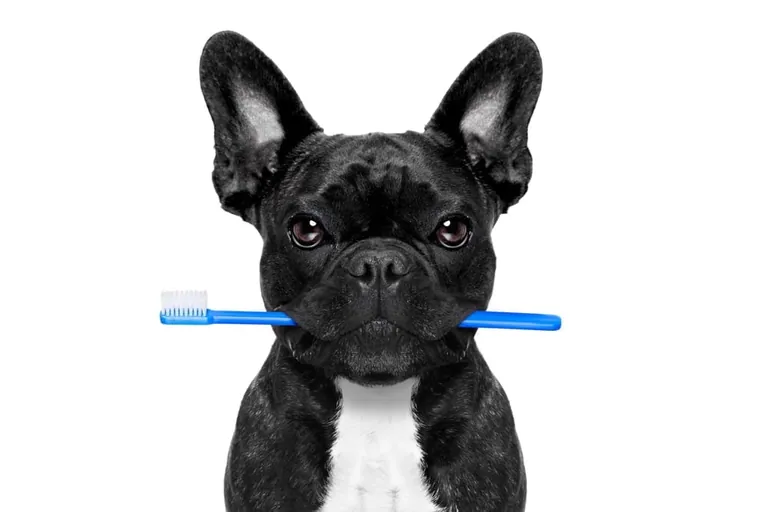
Start slowly: let your dog lick the paste, then touch the brush to a few teeth, and build up over a couple of weeks. The outside surfaces are where tartar collects, so those matter most.
Choose chews that give. Hard nylon bones, antlers and hooves can fracture teeth, which is a bigger risk in a mouth where teeth already take odd angles. A chew you can dent with a thumbnail is a safer bet.
Make food easier if eating is a struggle. Adding warm water to dry food or switching to wet food helps a dog who finds kibble awkward to pick up. If your dog is dropping food or losing weight, that’s a vet visit, not a feeding tweak.
Have the mouth checked at every appointment, and ask about a professional cleaning under anesthesia when tartar builds up. Our teeth guide covers what to look for between visits, and our health issues guide covers the rest of the breed’s common problems.
The short version
A French Bulldog’s underbite is the breed working as designed, and in most dogs it causes no trouble at all. The thing worth your attention is what comes with it: a small, crowded mouth that collects plaque quickly. Brush daily, keep an eye out for sores or difficulty eating, and let your vet judge whether anything more is needed.