French Bulldog
Frenchton: The French Bulldog and Boston Terrier Cross
What a Frenchton is, how the cross differs from a French Bulldog, what the research says about whether it's actually healthier, and what to ask a breeder.

Table of contentsContents
A Frenchton is a cross between a French Bulldog and a Boston Terrier. You’ll also see them sold as Faux French Bulldogs, Frenchbos, Boston Bulldogs or Frenchie Terriers — all the same cross, marketed under whichever name sells.
They’re usually bred either from one purebred parent of each breed, or by crossing a French Bulldog back to an existing Frenchton. The cross appeared in the United States in the 1990s, and much of its appeal rests on a claim worth examining carefully: that mixing in a Boston Terrier produces a healthier dog.
The health claim, examined
The claim is partly true and frequently overstated.
What supports it: Boston Terriers genuinely are less affected by breathing problems than French Bulldogs. In a study comparing screw-tailed breeds, 37.5% of Boston Terriers scored BOAS grade 0 — free of respiratory signs — against 10% of French Bulldogs and 15.2% of Bulldogs, and the authors concluded Boston Terriers “appear to be less severely affected by BOAS than the most popular extreme brachycephalic screw-tailed breeds” (Tomlinson and colleagues, 2024).
What undercuts it: three things.
First, “less severely affected” is not “unaffected”. Boston Terriers are still a flat-faced breed, and the same study found that within Boston Terriers, a shorter muzzle still raised BOAS risk.
Second, a cross inherits from both parents, and which traits a given puppy gets is not something a breeder controls. A Frenchton can end up with a face as flat as the Frenchie parent’s.
Third, the general belief that designer crossbreeds are healthier doesn’t hold up. RVC research comparing common designer crossbreeds with their parent breeds found their overall health largely similar (RVC VetCompass). Crossbred dogs do appear to live around a year longer on average, but they show lower rates for only a handful of the twenty most common disorders.
So: a Frenchton may breathe more easily than a French Bulldog. Buying one is not a guarantee of a healthy dog, and it doesn’t remove the need to check the parents.
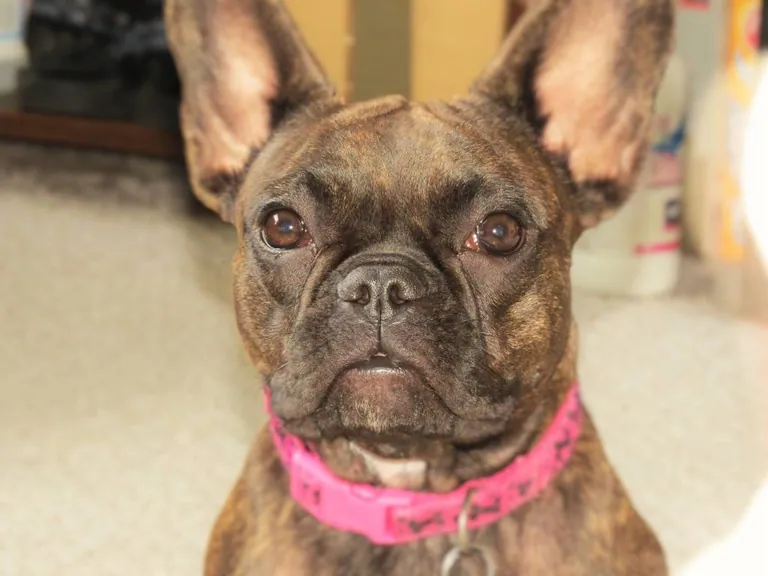
Frenchton vs French Bulldog
| French Bulldog | Frenchton | |
|---|---|---|
| Type | Purebred | Crossbreed |
| Origin | England, then France | United States, 1990s |
| AKC recognition | Recognized | Not recognized; listed by crossbreed registries |
| Muzzle | Very short | Often slightly longer, but varies |
| Size | Up to 28 lb | Typically 13–25 lb, but varies |
The honest summary of the differences is that a Frenchton is more variable. Two puppies from the same litter can differ in size, face shape and coat.
What they’re like to live with
Frenchtons are companion dogs: affectionate, people-focused, usually good with children and other pets, and happy in an apartment. They’re not typically big barkers, though many will announce a visitor.
They shed a little, and a weekly brush handles it. Ears need checking, and any facial folds need cleaning and drying, because folds trap moisture and skin fold dermatitis follows (PDSA).
Bathe when they need it rather than on a fixed schedule. Our bathing guide covers the routine, and the teeth guide applies too, since crowded teeth in a short jaw come with either parent breed.
Exercise is modest: a couple of short walks and some indoor play. Watch the heat, and stop if breathing turns noisy or laboured (VCA Animal Hospitals).
Health problems to know about
A Frenchton can inherit problems from either side:
- BOAS, less likely than in a French Bulldog but far from excluded.
- Skin fold dermatitis, wherever there are folds.
- Eye problems, including cherry eye and corneal ulcers, both common in flat-faced dogs.
- Allergic skin disease, which affects French Bulldogs at 8 times the odds of other dogs (O’Neill and colleagues, 2021).
- Patellar luxation, common in small breeds and graded I to IV (ACVS).
- Heat intolerance, for the same reasons as either parent.
Earlier versions of this article also listed perineal hernia. That was carried over from our French Bulldog health article in error — it’s a failure of the pelvic diaphragm seen mostly in older, uncastrated male dogs, not a breed-associated problem here.
Buying one
Because Frenchtons aren’t recognized by the AKC, there’s no breed club standing behind the breeding, and the registries that do list them set a much lower bar. That puts more weight on you.
Ask about both parents:
- Have they been BOAS graded? Ask to hear the parents breathe, ideally after light exercise.
- What health testing has been done — hips, patellas, eyes and heart, as the French Bull Dog Club of America sets out for the Frenchie side?
- Can you meet the mother with the litter, in the home where they were raised?
- Was the litter delivered naturally or by caesarean?
Our list of questions to ask a French Bulldog breeder applies in full, and the red flags are identical: several breeds available at once, pressure to pay a deposit, no health records, meeting in a car park.
Adoption is worth a look too. Crossbreeds turn up in breed rescue, and our guide to buying or adopting weighs the two routes.
Is a Frenchton right for you?
They suit people who want a small, affectionate, low-exercise companion, and who won’t be out of the house for long stretches.
Just buy one for what it is rather than for what it’s marketed as. A Frenchton is a crossbred flat-faced dog that may breathe more easily than a French Bulldog — not a French Bulldog with the health problems removed. Check the parents, and budget for vet care either way.