
Dog Training
French Bulldogs and Kids: Making It Work Safely
Frenchies are usually good with children, which is not the same as safe unsupervised. How to set the house up, what to teach a child, and the signals to watch for.
Table of contentsContents
French Bulldogs are usually excellent with children. They were bred to be companions, they’re small, and most of them genuinely enjoy the noise and company of a family.
That is not the same as safe unsupervised, and the difference is where children get hurt. Over a decade of cases at one children’s emergency department, the factors that never changed were the same three: a young child, bites to the head and face, and a dog the child already knew (Bykowski and colleagues, 2019).
Not strange dogs. Familiar ones. Which means the work is in your own house.

Why children are at particular risk
A small child’s face is at the height of a standing dog’s mouth, so a bite that would catch an adult on the hand catches a child on the face. Children also do, in perfect innocence, most of the things dogs dislike most: hugging, leaning over, grabbing at the face, climbing on, arriving suddenly at speed.
And a child can’t read the early warnings, or back off when they see them. That part is an adult’s job.
Frenchies have their own reasons to object. They sleep deeply and startle badly when woken. Their eyes are prominent and easily hurt. Many have a spine that doesn’t appreciate being sat on, and any dog in pain has a shorter fuse (AVSAB).
Set the house up
Most of this is arrangement rather than training.
- Give the dog a place children never go, and make it absolute: a bed in a quiet corner, or a crate with the door open. Nobody follows the dog there, nobody reaches in, nobody wakes them.
- Feed the dog away from the children, behind a door if necessary. Food, chews and a favourite toy are what dogs most often guard, and no child should be learning that lesson experimentally.
- Use a stairgate. The ability to separate the two without a fuss is worth more than any amount of training.
- Put chews away when children are moving around freely.
Teach the dog that children are good news
A dog who gets sent away whenever the baby appears learns that children predict losing your attention. Do the opposite:
- Feed treats, or do something the dog enjoys, while the child is present rather than after they’ve gone.
- Take the dog along on the walk with the pram, rather than leaving them behind.
- If the dog chooses to leave, let them. A dog who knows they can go is far less likely to feel they must escalate.
- Reward the dog for settling in their own place on cue, generously and often. Our training guide covers building that.
Never shout at the dog for showing interest in a child, and never punish a growl. A growl is information, and a dog punished for it may stop warning next time (AVSAB). If it happens, separate them calmly and work out what the dog was telling you; our guide to aggression covers reading the earlier signals.
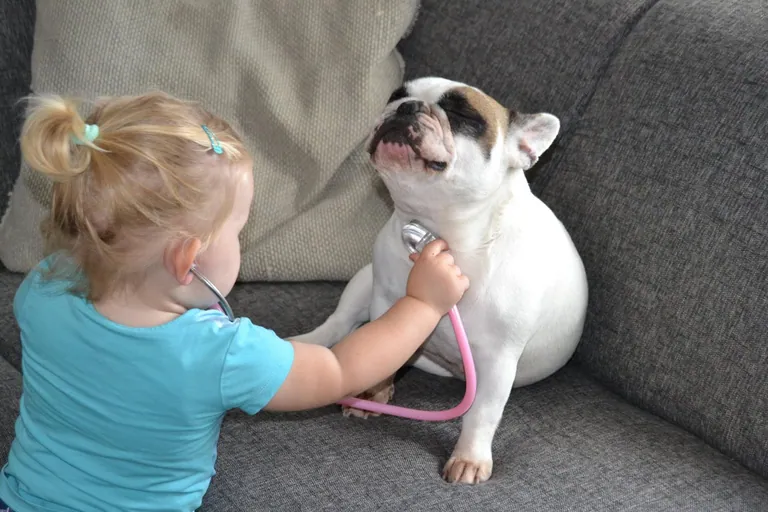
Teach the child
Keep it to a few rules a child can actually hold onto:
- The dog’s bed is the dog’s. Nobody goes in, reaches in, or wakes a sleeping dog.
- Leave the dog alone while eating or chewing.
- No hugging, no lying on, no climbing on, no picking up. Hugging in particular reads as being trapped.
- Stroke under the chin or along the back, not over the top of the head.
- If the dog walks away, they’re done. Let them go.
- Play games that don’t involve grabbing. Hiding a toy for the dog to find works well for both, and nobody has to take anything out of anybody’s mouth.
Older children can help with feeding and training, which is good for the relationship on both sides. What no child should be given is responsibility for controlling the dog: a child can’t enforce anything with a dog, and shouldn’t be asked to. Adults supervise; children are taught how to behave around the dog.
Supervision means being in the room
Supervision is not the dog and the toddler in the lounge while you cook. It means an adult close enough to intervene before anything escalates, actively watching rather than half-watching a screen.
Never leave a young child and a dog alone together, whatever the dog, however long you’ve had them, however good they’ve always been. This is the single rule that prevents the most harm, and it’s the one people relax first.
Watch for the quiet signals
Dogs almost always warn before they bite, but the early signals are easy to miss:
- Turning the head away, lip-licking, yawning when not tired.
- Whites of the eyes showing as the dog looks sideways.
- Going still or freezing, especially over food or a toy.
- Getting up and leaving, repeatedly.
Those mean the dog is uncomfortable now. Intervene then, and the growl never has to happen (VCA Animal Hospitals).
Dogs you meet outside
Children who live with a friendly Frenchie often assume every dog is that dog. Teach three rules for meeting one:
- Ask your grown-up. If there isn’t one, don’t pet.
- Ask the dog’s owner. If there isn’t one, don’t pet.
- Let the dog come to you. Put a hand out low and wait. If the dog doesn’t come over, they don’t want to be touched, and that’s the end of it.
Two things worth telling children plainly: a dog that looks sweet can still bite, and a wagging tail doesn’t mean a happy dog. Wagging means the dog is aroused, which can be delight, uncertainty or a warning depending on how high and how fast the tail is moving.
If a strange dog rushes up, teach a child to stand still, fold their hands away, and look somewhere else rather than run or scream. Running triggers chasing.
Bringing a baby home
Start weeks before, not on the day. Get the dog used to the pram, the cot and the sounds. Set up the gates and the dog’s new sleeping place early, so the changes aren’t associated with the baby’s arrival. Keep walks and meals at their usual times.
Then, when the baby arrives, be dull about it. Calm, ordinary, treats around the baby, and no exclusion. Our puppy guide covers early socialization if you’re going the other way and bringing a puppy into a house that already has children.
When to get help
Talk to your vet if the dog growls or snaps at a child, if a settled dog’s behaviour changes suddenly, if they’ve started avoiding the children, or if you’re managing by keeping them apart more and more. Your vet will rule out pain first, then refer you to a qualified reward-based behaviourist. Early is much easier than late.
The short version
A French Bulldog and children usually suit each other very well. Give the dog somewhere the children never go, feed them separately, teach children to leave a dog alone when it’s eating or sleeping, learn the quiet signals, and never leave the two alone together. Do that and the friendship largely takes care of itself.