French Bulldog
Merle French Bulldogs: Where the Colour Comes From, and What It Costs the Dog
Merle isn't a French Bulldog colour: it's a gene from another breed. What it does, why merle-to-merle breeding is dangerous, and what cryptic merle means for buyers.
Table of contentsContents
Merle is not a French Bulldog colour. It is a gene that does not exist in the breed’s gene pool, so every merle French Bulldog has another breed somewhere behind it, usually within the last few generations.
That’s not a technicality. It changes what you’re buying, what the dog is likely to face, and what questions matter when you talk to a breeder.
What merle actually does
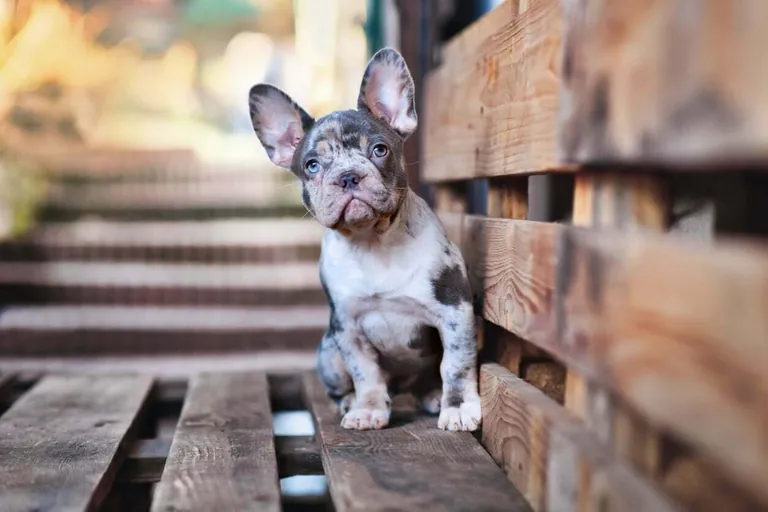
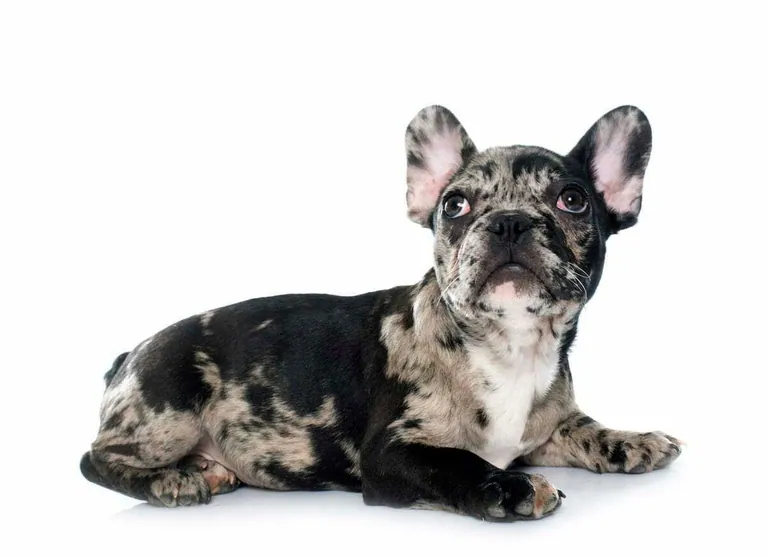
Merle comes from a stretch of DNA inserted into the PMEL pigment gene, often called SILV. It doesn’t add colour; it removes it, in patches. Dark pigment gets randomly diluted across the coat, leaving irregular lighter areas over a darker base, which is the mottled pattern people recognize.
The original version of this article described merle as “a dominant gene that becomes diluted by other genes”. It’s the other way round: merle is the diluter, and the base colour it acts on is set by separate genes entirely.
That’s where the sales names come from. A “blue merle” is merle acting on a dog that also carries the dilution gene; a “lilac merle” is merle on a diluted chocolate base. Both of those base colours are themselves disqualifications under the breed standard (AKC), so the fancier the name, the more disqualifications are stacked inside it. Our colours guide covers each one.
Where it came from
Merle had to be introduced from another breed, and Chihuahuas are the cross usually named. Whatever the source, a merle Frenchie’s pedigree has a dog in it that wasn’t a French Bulldog.
The breed standard doesn’t recognize merle, and the breed club’s position on colours sold as rare is blunt: breeders who “breed for and advertise rare colors are intentionally spreading unacceptable color genes through the gene pool” (FBDCA).
So a merle Frenchie is, genetically, a crossbred dog being sold at a purebred premium, usually several thousand dollars and sometimes far more. You’ll see a lilac merle quoted at close to $30,000; this article used to quote it too. Those figures are advertising, not a market.
The part that matters most: two merles
Never breed merle to merle. This is the one rule in the whole subject, and the original version of this article broke it in its own FAQ, telling readers that two merle French Bulldogs “can then be bred to create more” a few paragraphs after saying it was strongly discouraged.
A dog with one copy of merle is a single merle. A dog with two is a double merle, and the pattern that makes the coat pale also affects the inner ear and the developing eye. In 153 merle dogs tested by brainstem response, 2.7% of single merles were deaf in one ear and 0.9% in both. Among double merles it was 10% in one ear and 15% in both (Strain and colleagues, 2009).
Eye defects run with it: abnormally small eyes, irregular pupils, colobomas, and in bad cases very poor sight from birth. A double merle litter is not a risk a buyer carries; it’s one the breeder chose.
Cryptic merle, and why “he isn’t merle” isn’t enough
Here’s what the original article never mentioned, and it’s the reason double merles get bred by people who didn’t mean to.
The merle insertion varies in length, and the length determines how much it shows. Short versions, called cryptic merle, produce a dog that carries merle while looking like an ordinary solid-coated dog (Langevin and colleagues, 2018). Mate a cryptic merle to a visible merle and you can get double merle puppies from a pairing that looked perfectly safe.
The practical consequence: eyes are not a merle test. In any line where merle has been introduced, the only way to know is a DNA test that reports the allele length, and any breeder producing merle should be testing both parents and showing you the results.
Everything else a French Bulldog brings
Merle sits on top of the breed’s own problems rather than replacing them. Compared with other dogs in the UK, French Bulldogs had 42 times the odds of narrowed nostrils, 31 times the odds of brachycephalic obstructive airway syndrome, 14 times the odds of ear discharge and 11 times the odds of skin fold dermatitis (O’Neill and colleagues, 2021).
Our health issues guide covers those, and insurance is worth arranging before anything is diagnosed and therefore excluded.
If you’re buying one
- Ask for merle DNA results on both parents, with allele lengths, not a verbal assurance.
- Ask what the other parent is. If merle is present, something in the line wasn’t a French Bulldog, and a breeder who won’t discuss that is not the breeder you want.
- Ask for a BAER hearing test on the puppy. It’s the only objective way to check hearing, and it takes minutes.
- Have the eyes checked by a vet before you commit.
- Watch the parents breathe at rest. Colour is the least of this breed’s problems; our breeder questions guide covers the rest.
A deaf or partially sighted dog can live a good life with an owner who wants that job. What nobody should do is buy one by accident, from someone who didn’t test.
Is it ethical to buy one?
The honest answer is that the demand is the mechanism. Merle exists in this breed because it sells, and each premium paid funds the next litter.
That doesn’t make an individual merle Frenchie less deserving of a home, and a dog already born needs one. But “rescuing” a puppy from a breeder by paying for it is buying, and the breeder reads it as an order. If you want the dog rather than the pattern, rescue is where dogs genuinely need homes.
Care, briefly
Nothing about the coat changes day-to-day care, and everything in our health issues guide applies.
- Brushing once a week is plenty; our shedding guide covers what’s normal.
- Bathing when the dog needs it rather than on a schedule, with folds and ears dried properly. Our washing guide covers it.
- Weight matters more than in most breeds. If your dog is gaining, measure the food and cut the treats rather than switching foods; our weight guide covers body condition, and our food guide covers diet.
- Exercise in the cool part of the day, in short walks.
- A deaf dog needs hand signals and a lead in unfenced space; our training guide covers building visual cues.
The short version
Merle isn’t a rare French Bulldog colour, it’s a gene borrowed from another breed and sold at a premium. One copy gives you the pattern; two give a one-in-seven chance of a dog deaf in both ears, and because cryptic merles don’t look merle, that pairing can happen by accident. If you’re buying, the DNA results on both parents matter more than anything on the puppy’s coat.