Dog Breeds
All You Want To Know About The Cute Newfoundland Lab Mix
A Newfoundland Lab Mix is a giant dog - 90 to 150 pounds. What to expect on temperament, grooming, heat sensitivity, and the inherited health conditions worth screening for.
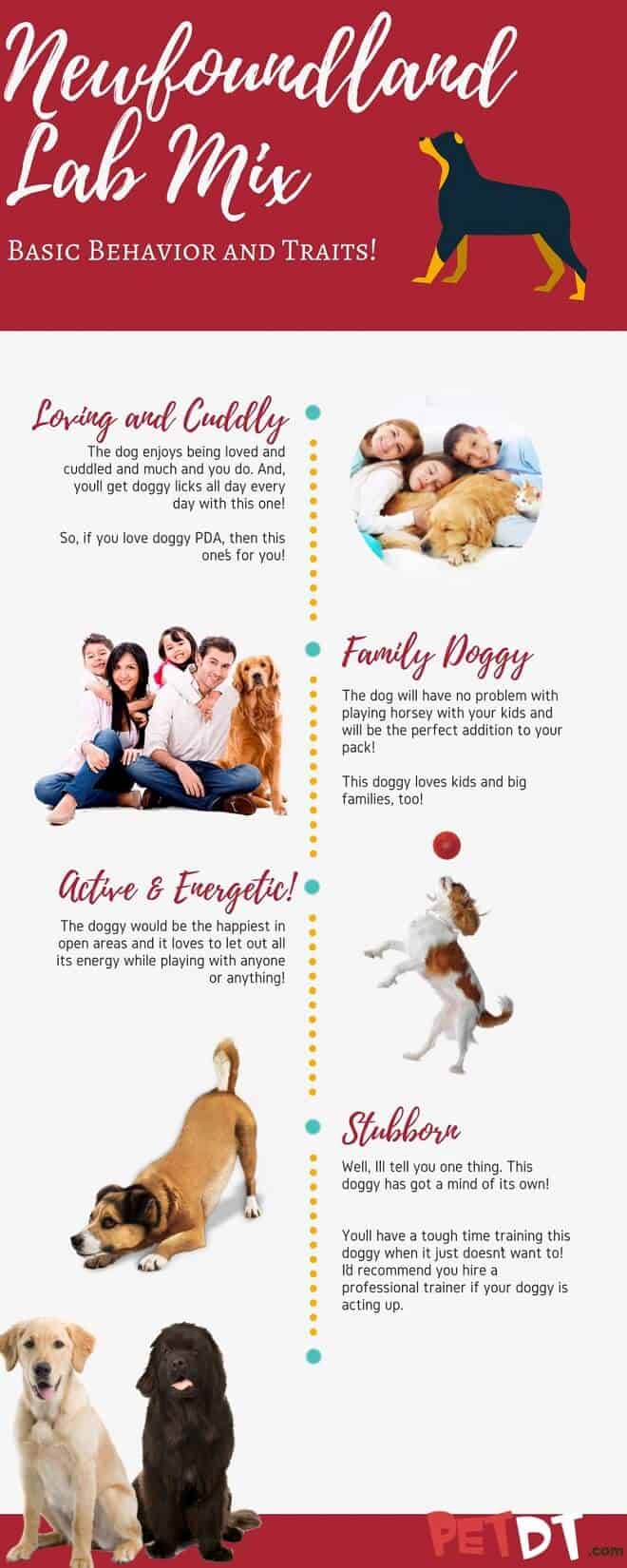
Table of contentsContents
Are you looking for a sweet family dog?
Then the Newfoundland Lab Mix is worth a look. It also goes by Newfador or Labrafoundland.
As the name suggests, it’s a cross between the large and fluffy Newfoundland and the endlessly cheerful Labrador Retriever.
One thing to be clear about before anything else: this is a giant dog. A Newfoundland can reach 150 pounds and a Lab 80, so a cross typically lands somewhere between 90 and 150. Everything below follows from that — the cost, the exercise, the health risks and the amount of hair.
How Cute and Cuddly Are They?
Because this is a mixed breed, you can’t fully predict how any individual puppy will look or behave. Each one draws differently from its two parents, and a single litter can vary a lot.
That said, here’s what usually comes through.
1. What Colors Does It Come In?
Usually black with white or lighter markings, or white with black or tan patches.
2. How Soft Is The Coat?
The coat goes one of two ways depending on which parent wins out:
- Short and shiny, like a Lab
- Long and fluffy, like a Newfoundland
Either way it’s a double coat — a dense insulating undercoat beneath a weather-resistant outer layer. That’s what makes these dogs so pleasant to sit next to in winter, and it’s also the source of most of the practical difficulties further down this page.
3. Is The Face Adorable?
The nose and muzzle usually resemble the Labrador Retriever parent, and the eyes are typically a shade of brown.
The head is broad and the expression is soft. It’s a hard dog to say no to, which is worth being aware of when you’re deciding whether you can actually accommodate one.
4. What About The Feet and Tail?
Big paws, like the Newfoundland, with the partial webbing both parent breeds carry — both were bred for water work, which is why so many of these dogs take to swimming without any encouragement.
The tail usually resembles the Labrador’s: thick, otter-like, and powerful enough to clear a coffee table.
Will The Dog Fit My Lifestyle And Needs?
It’s worth being honest with yourself about compatibility before you commit, because rehoming a 130-pound dog is considerably harder than rehoming a small one.
Loving and Cuddly
Both parent breeds are affectionate, and the cross is no exception. This is a dog that wants to be in the room with you, and one that has no concept of being too large for a lap.
Family Dog
Newfoundlands have a long reputation for patience with children, and Labs are much the same. It’s a good combination for a family.
The caveat is size rather than temperament. A friendly giant-breed dog can knock a small child over without any ill intent, so early training around greeting people matters more here than it would with a spaniel.
Active, But Not In The Way You Might Think
These dogs enjoy swimming, walking and being outdoors — but an adult’s exercise needs and a puppy’s are completely different, and getting this wrong causes lasting damage.
A giant-breed puppy’s growth plates stay open until around 18 to 20 months. Until they close, high-impact exercise can cause micro-trauma that leads to premature closure, uneven limb growth and early joint disease. Long hikes, jogging and jumping are exactly the wrong thing for a puppy of this size.
A widely used guideline is five minutes of formal exercise, twice a day, for every month of age — so twenty minutes twice daily for a four-month-old. Free play on grass at their own pace is fine and good for them. Save the long walks and trekking for after eighteen months.
An adult in open space, doing what the breed was built for:
Stubborn
Both parents are intelligent, and both have an independent streak. Training is straightforward with positive reinforcement and consistency, but a 130-pound dog that has decided not to walk any further is not a dog you will be moving. Get the recall and the loose-lead walking established while they’re still liftable.
Heat: The Thing Most People Underestimate
That double coat was built for Newfoundland winters, not for July.
These dogs are markedly heat-intolerant and prone to heatstroke. Flat-faced breeds like the pug struggle in heat because of their airway; a Newfoundland cross struggles because of insulation. Same risk, different cause. In warm weather, walk early morning or late evening, keep water available constantly, and never leave one in a car or a conservatory even briefly.
Signs to act on immediately: heavy frantic panting, drooling more than usual, unsteadiness, bright red gums, vomiting. Heatstroke is an emergency — cool the dog with room-temperature water and get to a vet.
And don’t shave the coat to keep them cool. It doesn’t work the way people assume. The undercoat insulates against heat as well as cold, and shaving removes the sun protection while risking permanent changes to how the coat regrows.
Health: What To Ask A Breeder About
This section matters more than any other on the page, because both parent breeds carry serious inherited conditions and a cross can inherit from either side.
Subvalvular aortic stenosis (SAS). A hereditary heart defect that Newfoundlands are particularly prone to. Extra tissue below the aortic valve obstructs blood flow, forcing the heart to work harder. Signs include exercise intolerance, lethargy and fainting, especially during activity. It can cause sudden death in young dogs. A responsible breeder screens the parents by cardiac exam.
Bloat, or gastric dilatation-volvulus (GDV). The stomach fills with gas and then twists, cutting off blood supply. Deep-chested giant breeds are at the highest risk, and it kills quickly. Signs are a distended abdomen, unproductive retching, restlessness and laboured breathing. This is a same-hour emergency, not a wait-and-see. Some owners of at-risk breeds elect a preventive gastropexy during spay or neuter — worth discussing with your vet.
Cystinuria. A genetic kidney defect that lets cystine build up in the urine and form crystals and stones, which can block the urethra. Newfoundlands are a known carrier breed, and a DNA test exists.
Hip and elbow dysplasia. Both parent breeds carry it, and the fast growth of a giant-breed puppy compounds the risk. Ask for hip and elbow scores on both parents.
None of this means the cross is unhealthy. It means you should buy from someone who screens, ask to see the results rather than take their word, and keep your dog lean — excess weight is the single biggest avoidable contributor to joint disease in large breeds.
What About Shedding, Bath Time, and Grooming?
Shedding
Considerable, and constant, with heavier seasonal periods. A double coat sheds year-round and then blows out twice a year.
Plan on brushing several times a week, and daily when the coat is coming out. A robust vacuum is not optional.
Bath Time and Grooming
Professional grooming at regular intervals is worth budgeting for, particularly with a long-coated dog — a matted double coat is a job for someone with the right equipment.
Bathe roughly once a month. More often than that strips the natural oils and leaves the coat dull and the skin dry.
Shampoos that suit this coat:
- Pro Pet Works All Natural Soap Free Oatmeal Shampoo & Conditioner
- Rocco & Roxie Grooming and Dog Spa Shampoo
- Wahl Natural Pet Shampoo
Dry thoroughly afterwards. A dense undercoat left damp is how hot spots start.
Why Shouldn’t I Get A Newfoundland Lab Mix?
Some honest reasons to walk away.
The Exercise Commitment
An adult needs real daily exercise, and you’ll be doing it in all weather. If that doesn’t fit your life, this isn’t your dog.
Apartments are a poor fit, though space matters less than the walking does.
Separation Anxiety
Both parent breeds bond hard and neither copes well alone for long stretches. If the house is empty ten hours a day, choose a different breed or arrange company.
Hair, Everywhere
You will find it on your clothes, in your car, and at work. This never stops. It’s simply the deal.
Drool
Newfoundlands drool, and the cross often does too. Expect it on walls, furniture and visitors. Cloths by the door help.
Cost
The one people forget. A giant breed eats accordingly, and everything scaled to their size — beds, crates, preventive medication, and anaesthetic for any procedure — costs more. Insurance premiums are higher for giant breeds, and the surgeries they’re prone to are not cheap.
So, What’s The Verdict?
The Newfoundland Lab Mix is a sweet, calm, affectionate giant that suits an active family with room and time.
Coat and colour vary — short and shiny or long and fluffy, usually black and white or white with darker patches — and, like any mixed breed, no two puppies are alike.
They’re playful, and they’re hard on toys, so it is worth starting with something built to last. Sturdy options like the Playfur Pets IQ Ball or the Kong Cozie last better than most.
They shed heavily, need regular grooming, drool, dislike the heat, and carry real inherited health risks worth screening for. Understand all of that going in and you’ll get one of the most good-natured dogs there is.
Leave a comment if you’ve got questions.
PetDT Editorial Team
The PetDT Editorial Team manages and maintains our library of legacy pet care content. With experience across a wide range of pets, including dogs, cats, fish, hamsters, and reptiles, the team works to review and improve older articles so they remain accurate, clear, and helpful for everyday pet owners. As PetDT continues updating inherited content, articles credited to the Editorial Team will be reviewed by Mike or Melissa during the update process.
View all posts by PetDT Editorial Team