
French Bulldog
Pigeon Chest in French Bulldogs: How Common It Is and When It Matters
Pigeon chest affects about one in five French Bulldogs and usually causes no symptoms. What it is, how it differs from sunken chest, and when treatment is needed.
Table of contentsContents
Pigeon chest is a breastbone deformity where the sternum juts outward. It turns up often in flat-faced, screw-tailed breeds, French Bulldogs included, and the good news is that in most dogs it causes no trouble at all.
The condition it gets confused with, sunken chest, is the one that can be serious. Knowing which your dog has matters.
What pigeon chest is
The medical name is pectus carinatum: the sternum and the cartilage attaching the ribs to it grow outward, so the chest looks keeled or pointed rather than smoothly rounded. It’s present from birth, and it’s thought to be genetic.
In a study of 124 screw-tailed brachycephalic dogs, pigeon chest appeared in 11.3% overall: 41.2% of Pugs and 18% of French Bulldogs, and in none of the other breeds examined (Komsta and colleagues, 2019). So roughly one French Bulldog in five has some degree of it.
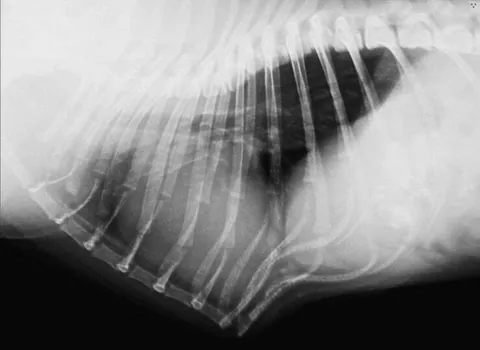
Image from Komsta and colleagues, 2019, published under a Creative Commons licence.
Does it cause problems?
Usually not. The same researchers noted that pigeon chest is “only sporadically discussed in veterinary literature, probably due to the common belief that this defect produces no clinical symptoms in animals”, and among their dogs only one showed respiratory distress during exercise.
That’s worth holding onto, because you’ll read a lot online about pigeon chest causing breathing difficulty, heart problems and impaired ventilation. Those descriptions mostly belong to the other deformity.
If your Frenchie does have noisy breathing, exercise intolerance, gagging or snorting, the far more likely explanation is brachycephalic obstructive airway syndrome, which affects the great majority of the breed (PDSA). Our health issues guide covers BOAS, and it’s the thing worth investigating rather than assuming the chest shape is to blame.
The other one: sunken chest
Pectus excavatum is the opposite shape: the sternum curves inward toward the spine, reducing the space in the chest. It’s about four times more common than pigeon chest in these breeds, and it’s the one that can compress the heart and lungs, cause progressive cardiorespiratory problems, and in severe cases be life-threatening.
Treatment depends on age. In very young puppies, the chest is still flexible, and a non-invasive approach works well: sutures placed around the sternebrae and attached to an external splint pull the breastbone outward, and the splint comes off within a few weeks once the correction holds (Fernández and colleagues, 2023). In older dogs, open surgery is possible but carries higher morbidity and mortality, which is why early diagnosis matters so much with this one.

What else often comes with it
Screw-tailed breeds tend to accumulate structural problems together. The same study looked at tracheal hypoplasia (an abnormally narrow windpipe), thoracic spine deformities and displacement of the heart, all of which occur alongside chest deformities in these dogs.
Spinal malformations are especially common in French Bulldogs: 90% to 100% of dogs examined had at least one abnormal vertebra (UFAW). Most never show signs, but when they do it’s usually before seven months, with hind-leg weakness, pain or incontinence. Our tail guide covers hemivertebrae in more detail.
A vet finding a chest deformity may therefore want to look at the spine and windpipe too.
Getting a diagnosis

Your vet will start by feeling and looking at the chest. X-rays show the shape and severity and rule out other causes, and an echocardiogram may follow if there’s any question about the heart, particularly with sunken chest.
Worth doing if:
- The chest shape looks unusual, especially in a puppy.
- Your puppy is not thriving, or tires much faster than littermates.
- There’s noisy breathing, gagging, or exercise intolerance at any age.
For a puppy with sunken chest, don’t wait. The non-invasive treatment window is measured in weeks.
Living with a dog who has pigeon chest
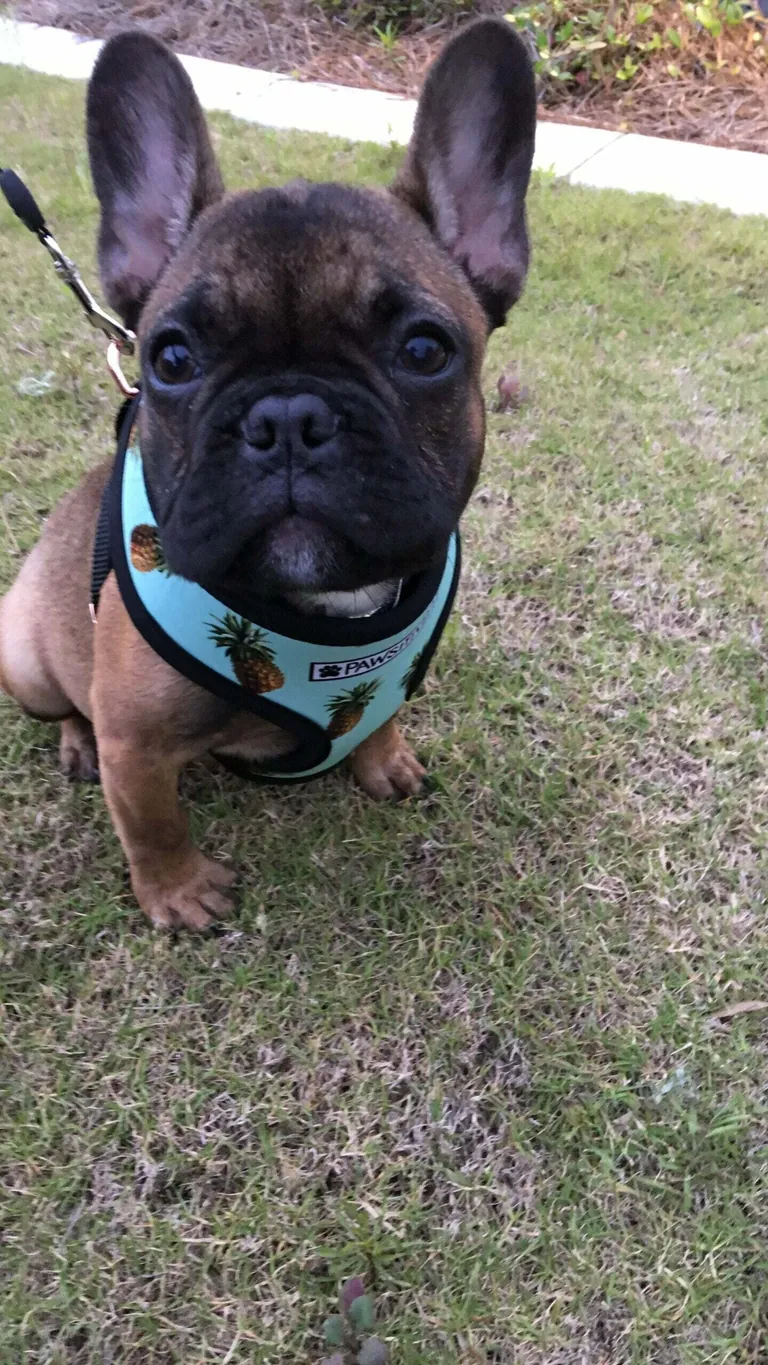
For most dogs, nothing changes. A Frenchie with a mild keel-shaped chest needs the same care as any other Frenchie: kept lean, kept cool, walked in the cool part of the day, and seen by a vet if breathing changes.
- Weight matters more than usual. Extra weight makes breathing harder in a breed already short of airway; our weight guide covers body condition scoring.
- Harness, not collar, so nothing presses on the throat. Our harness guide covers fitting.
- Watch the heat. Our guide to walking a French Bulldog covers how much is sensible.
- Tell your vet what you’re seeing if anything changes, rather than assuming it’s the chest.
If your dog does have breathing problems, exercise should be guided by your vet rather than a fixed schedule, and the underlying cause is what needs treating.
Breeding

Chest deformities are congenital and believed to be inherited, so the practical prevention is in breeding decisions rather than anything an owner does afterwards. Dogs with significant chest deformities shouldn’t be bred from, and it’s worth telling your breeder if your puppy turns out to have one, since they may not know.
If you’re choosing a puppy, our breeder questions guide covers what to ask about health testing, and our puppy guide covers the first year.
The short version
Pigeon chest is common in French Bulldogs, affecting roughly one in five, and in most dogs it causes no symptoms and needs no treatment. Sunken chest is the one to catch early, especially in puppies, because the easy fix only works while the chest is still soft. And if a Frenchie is struggling to breathe, the chest shape is rarely the reason: BOAS usually is.